Parallel Lives
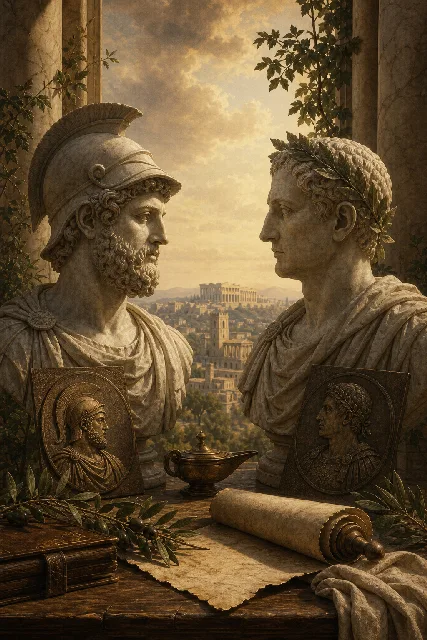
Parallel Lives
Paired biographies that turn character into political and moral instruction.
About this book
Plutarch's Parallel Lives compares Greek and Roman figures to understand ambition, courage, judgment, vanity, virtue, and failure. These are not neutral biographies; they are moral portraits designed to make readers watch character under pressure. The work shaped centuries of political imagination because it treats history as a storehouse of examples, warnings, and questions about public life.
How do you want to read?
- THESEUS, Part 14720 words
This chapter introduces Theseus, the legendary founder of Athens, and sets the stage for his heroic journey. We learn of his mysterious birth, his upbringing, and the dangerous path he chooses to prove his worth.
- THESEUS, Part 24585 words
Theseus sails for Crete with the tribute youths, determined to slay the Minotaur. The labyrinth awaits, but so does Ariadne's thread. What follows is a tale of heroism, love, and the founding of Athenian traditions.
- THESEUS, Part 33119 words
This chapter explores the later years of Theseus, including his controversial marriages, his friendship with Pirithous, and the events that led to his downfall. The narrative weaves together various traditions and historical accounts.
- ROMULUS, Part 14664 words
As the city of Rome begins to take shape, the story of its founders weaves together myth and history. The chapter explores the competing legends surrounding Romulus and Remus, setting the stage for a fateful dispute.
- ROMULUS, Part 24419 words
Romulus builds Rome's foundations with laws and social order, but faces a pressing need for women to ensure the city's future. His bold plan to secure wives sets the stage for conflict and unexpected alliances.
- ROMULUS, Part 33653 words
Romulus's reign draws to a close with a mysterious disappearance. As we explore the final years, the chapter examines the legends and rituals that arose from his vanishing, setting the stage for his transformation into the god Quirinus.
- COMPARISON OF ROMULUS WITH THESEUS1573 words
This chapter closes the comparison of Theseus and Romulus, weighing their motives, deeds, and flaws. Plutarch argues that while Theseus acted from free will for others, Romulus's necessity-driven actions yielded more lasting success.
- LYCURGUS, Part 14400 words
As we delve into the life of Lycurgus, the legendary lawgiver of Sparta, we encounter a figure shrouded in mystery and contradiction. His reforms, from the senate to land redistribution, aimed at creating a stable and equal society.
- LYCURGUS, Part 24543 words
In this chapter, Lycurgus's reforms continue to shape Spartan society, from public meals to the education of youth. His methods, though harsh, aim to forge disciplined citizens. The following passages reveal the rigor of Spartan life.
- LYCURGUS, Part 34021 words
This chapter explores Spartan customs, from education and blunt speech to military discipline and social hierarchy. It also examines the controversial Cryptia and the treatment of Helots, raising questions about Lycurgus's true character.
- LYCURGUS, Part 41566 words
Lycurgus, satisfied with his laws, prepares to secure their permanence. He calls an assembly, administers an oath, and departs for Delphi, setting the stage for a final act of devotion.
- NUMA POMPILIUS, Part 14360 words
As Rome transitions from Romulus's mysterious end to the search for a new king, the city faces internal strife. The choice falls on Numa Pompilius, a Sabine of renowned piety and wisdom, whose ascension promises a shift from martial might to divine order.
- NUMA POMPILIUS, Part 24369 words
In this chapter, Numa Pompilius deepens Rome's religious foundations, instituting priestly orders and rituals that bind the city to divine law. His reforms aim to cultivate piety and order, setting the stage for a society governed by sacred traditions.
- NUMA POMPILIUS, Part 32329 words
Plutarch now details Numa's reform of the Roman calendar, a task requiring both science and diplomacy. He also explores the profound peace that marked Numa's reign, a stark contrast to Rome's usual state of war.
- COMPARISON OF NUMA WITH LYCURGUS2383 words
As we compare the lives of Lycurgus and Numa, their shared virtues of moderation and divine guidance come into focus, yet their paths diverge sharply in method and legacy.
- SOLON, Part 14424 words
As Solon steps onto the political stage, Athens teeters on the brink of civil strife. The city's debts and divisions demand a leader who can balance the hopes of the poor and the fears of the rich, without seizing absolute power.
- SOLON, Part 24273 words
As Solon's reforms take hold, the balance between rich and poor shifts, but not without controversy. His laws aim to stabilize Athens, yet the path forward remains uncertain.
- SOLON, Part 32305 words
Solon's encounter with Croesus tests his wisdom against wealth, but the true lesson lies in the fragility of fortune. Returning to Athens, he finds the city fracturing into factions, with a familiar ambition stirring beneath the surface.
- POPLICOLA, Part 14384 words
As Rome emerges from monarchy, a new leader rises-not through ambition, but through service. Poplicola's story begins with a choice that will define his legacy.
- POPLICOLA, Part 23202 words
This chapter recounts the dedication of the Capitoline temple and the heroic deeds of Horatius Cocles, Mucius Scaevola, and Cloelia, as well as the political and military successes of Poplicola.
- COMPARISON OF POPLICOLA WITH SOLON1275 words
This chapter compares Solon and Poplicola, examining who achieved greater happiness and good governance. As the analysis unfolds, their lives and reforms are weighed against each other.
- THEMISTOCLES, Part 14276 words
Themistocles, born to obscure parents, rises through ambition and cunning. His restless spirit, haunted by Miltiades' glory, drives him to prepare Athens for a greater war. The stage is set for his boldest moves.
- THEMISTOCLES, Part 24399 words
As the Greek fleet debates retreat, Themistocles must rally them to face the Persians at Salamis. His cunning and resolve will be tested in a battle that could decide the fate of Greece.
- THEMISTOCLES, Part 33668 words
Themistocles, once the savior of Greece, now flees his own people. Hunted by Athenians and Spartans, he takes a desperate gamble, seeking refuge with a former enemy. His path leads him toward an uncertain fate in Persia.
- CAMILLUS, Part 14563 words
As Camillus's star rose, his triumphs began to stir unease among the people. His pride and a forgotten vow would soon turn their admiration into resentment, setting the stage for a dramatic fall.
- CAMILLUS, Part 24015 words
As the Gauls descend on Rome, the city's fate hangs in the balance. Camillus, exiled and bitter, watches from afar as the Romans face their greatest test.
- CAMILLUS, Part 34291 words
As the Gauls hold Rome captive, hope stirs from an unexpected quarter. Camillus, exiled but undefeated, prepares to reclaim his city-but only if the Capitol commands it.
- CAMILLUS, Part 43217 words
Camillus faces a final test of leadership as Rome's internal strife threatens to undo its hard-won victories. The aging general must navigate both political turmoil and a renewed Gallic threat.
- PERICLES, Part 14406 words
Plutarch opens by reflecting on the proper use of inquiry and virtue, setting the stage for Pericles' life as an example of moral excellence. He argues that virtue inspires action, unlike mere artistic skill, and introduces his purpose in writing these biographies.
- PERICLES, Part 24495 words
Pericles now stands unchallenged, his power and vision reshaping Athens. Yet even as he builds and defends, tensions with Sparta simmer, and his cautious military philosophy faces its first test.
- PERICLES, Part 34221 words
As Pericles steered Athens through triumphs and tensions, his campaigns secured influence abroad while stirring controversy at home. This chapter explores his military successes, the delicate balance of power, and the personal ties that shaped his decisions.
- PERICLES, Part 44008 words
This chapter examines the disputed causes of the Peloponnesian War, focusing on Pericles' motives and his handling of personal and political crises. It recounts events from Phidias' downfall to Pericles' death and its aftermath.
- FABIUS, Part 14503 words
Fabius Maximus, appointed dictator after Hannibal's devastating victory at Lake Trasimene, must now face both the Carthaginian general and growing political opposition at home.
- FABIUS, Part 24322 words
As Rome's fortunes waver, the clash between caution and boldness intensifies. Fabius's steady hand and Varro's reckless ambition set the stage for a pivotal confrontation that will test the limits of strategy and fate.
- FABIUS, Part 32455 words
As Fabius nears the end of his life, his cautious strategies and personal rivalries come into sharp focus, setting the stage for a final clash of wills with the rising Scipio.
- COMPARISON OF PERICLES WITH FABIUS1034 words
As we weigh the lives of Pericles and Fabius, their contrasting fortunes in war and peace offer rich material for comparison. The chapter examines how each man's character shaped his response to vastly different circumstances.
- ALCIBIADES, Part 14211 words
Alcibiades, born to noble lineage and raised by Pericles, was a youth of striking beauty and ambition. His charm and insolence marked him early, but his encounter with Socrates would shape his path.
- ALCIBIADES, Part 24236 words
Alcibiades, driven by envy of Nicias, begins to undermine the peace with Sparta. His cunning diplomacy and personal ambition set the stage for dramatic shifts in Athenian policy.
- ALCIBIADES, Part 34551 words
As Alcibiades' star rises, his chameleon-like nature shifts from Spartan austerity to Persian luxury, weaving a web of alliances and betrayals that will test the limits of his influence.
- ALCIBIADES, Part 43374 words
Alcibiades returns to Athens amid great fanfare, restored to command. But his fortunes soon shift as a subordinate's defiance leads to defeat, and he faces exile once more.
- CORIOLANUS, Part 14342 words
In this chapter, we follow Caius Marcius from his youth through his early military exploits, witnessing the formation of a warrior whose valor is matched only by his pride. The seeds of future conflict are sown as his uncompromising nature begins to clash with the demands of civic life.
- CORIOLANUS, Part 24676 words
As Rome struggles with famine and internal strife, Marcius stands firm against the plebeians, setting the stage for a confrontation that will test the limits of pride and power.
- CORIOLANUS, Part 34732 words
Marcius, now Coriolanus, leads the Volscians against Rome. As the city reels from his advance, the Romans send repeated embassies, but he remains unmoved. The crisis deepens.
- CORIOLANUS, Part 42756 words
Volumnia and Vergilia lead the Roman women to the Volscian camp, hoping to sway Coriolanus from his path of vengeance. Their plea carries the weight of family and country.
- COMPARISON OF ALCIBIADES WITH CORIOLANUS1656 words
As Plutarch draws his comparison to a close, he weighs the final balance between two flawed yet formidable leaders, examining how their personal virtues and vices shaped their legacies.
- TIMOLEON, Part 14604 words
As Timoleon sets sail for Sicily, divine signs and human treachery test his resolve. The Corinthians' chosen general must navigate both political deceit and the legacy of his brother's death.
- TIMOLEON, Part 24528 words
Fortune shifts in Sicily as Timoleon's campaign gains momentum, but the fate of Syracuse hangs in the balance between Greek resolve and Carthaginian might.
- TIMOLEON, Part 34502 words
With tyranny demolished and a new colony planted, Timoleon turns to face the gathering storm from Carthage. The fate of Sicily hangs on the coming battle.
- TIMOLEON, Part 42423 words
As Timoleon’s campaign reaches its climax, the final tyrants fall and peace returns to Sicily. His greatest work now begins: rebuilding what war destroyed.
- AEMILIUS PAULUS, Part 14347 words
As Rome's war with Perseus falters, the people turn to an older, proven commander. Aemilius Paulus, known for his integrity and discipline, accepts the challenge, setting the stage for a decisive campaign.
- AEMILIUS PAULUS, Part 24245 words
As Aemilius Paulus prepares for the decisive battle against Perseus, the Roman general must overcome not only the formidable Macedonian phalanx but also the challenges of terrain and superstition. The stage is set for a confrontation that will determine the fate of Macedon.
- AEMILIUS PAULUS, Part 34620 words
Fortune shifts swiftly, as Aemilius Paulus stands at the peak of his triumph over Macedonia. But even in victory, he reminds us that human happiness is never secure, and the gods often balance great success with personal loss.
- AEMILIUS PAULUS, Part 41455 words
Aemilius Paulus, fresh from his triumph over Macedonia, addresses the Roman people with a speech that reveals his deep unease about fortune's fickleness, setting the stage for reflections on loss and legacy.
- COMPARISON OF TIMOLEON WITH AEMILIUS PAULUS808 words
As the lives of Aemilius and Timoleon draw to a close, the chapter weighs their virtues side by side. Both achieved great victories, but their responses to fortune and personal loss reveal deeper differences.
- PELOPIDAS, Part 14484 words
In this chapter, Plutarch sets the stage for Pelopidas's daring conspiracy by contrasting reckless courage with prudent valor. The narrative follows the Theban exiles as they prepare to liberate their city from Spartan domination.
- PELOPIDAS, Part 23989 words
As Thebes rises, Pelopidas and the Sacred Band prepare for a clash that will test Spartan might. The stage is set for a battle that will echo through Greek history.
- PELOPIDAS, Part 33511 words
Pelopidas, the Theban hero, sets out on a final mission to Thessaly, driven by a desire to liberate its cities from the tyrant Alexander. The omens are dark, but his resolve is unshaken.
- MARCELLUS, Part 14666 words
This chapter follows the career of Marcus Claudius Marcellus, a Roman general renowned for his martial prowess and single combat. From his early exploits to his consulship, his story unfolds against the backdrop of Rome's wars with Gauls and Carthaginians.
- MARCELLUS, Part 24524 words
As the Roman siege of Syracuse unfolds, Archimedes' genius turns the city into an impregnable fortress. But even the greatest minds cannot hold back fate forever.
- MARCELLUS, Part 33533 words
As Marcellus faces a new consulship, old enemies stir accusations from Syracuse. The trial that follows reveals his unshaken authority and the complex ties between victor and vanquished.
- COMPARISION OF PELOPIDAS WITH MARCELLUS1278 words
As we close this comparison of two great commanders, we weigh their victories and their ends. Marcellus and Pelopidas shared valor but differed in mercy and fate. Their stories invite reflection on what truly defines a leader's legacy.
- ARISTIDES, Part 14552 words
As Athens rose from the ashes of war, one man's unwavering justice set him apart-and made him a target. This chapter follows Aristides, whose virtue earned both love and envy.
- ARISTIDES, Part 24264 words
The Greeks prepare for the decisive battle at Plataea, guided by oracles and internal debates. Aristides navigates disputes over honor and position, while omens and a secret plot test their unity.
- ARISTIDES, Part 32675 words
As the dust of war settles, a new order emerges from the ashes. Aristides steps forward, not with sword or gold, but with a decree that will bind the Greek states in freedom and remembrance.
- MARCUS CATO, Part 14505 words
As Rome expands, a new kind of leader rises-one who values frugality and discipline over noble birth. This chapter introduces Marcus Cato, a man whose harsh virtues and sharp tongue would shape Roman morals for generations.
- MARCUS CATO, Part 24607 words
As Cato's censorship draws scrutiny, his unyielding moral rigor reshapes Rome. This chapter reveals the clash between austerity and indulgence, where public virtue meets private vice.
- MARCUS CATO, Part 34377 words
As Cato's life unfolds, we see his fierce dedication to shaping his son, managing his household, and opposing Greek influences-all while amassing wealth and power.
- MARCUS CATO, Part 4947 words
Plutarch deepens his comparison of Aristides and Cato, examining how each man's relationship with wealth and ambition reveals his true character. He argues that voluntary poverty can be a sign of virtue, not shame.
- PHILOPOEMEN, Part 14394 words
This chapter explores the life and character of Philopoemen, the last great Greek general, through his upbringing, military reforms, and key battles. It sets the stage for understanding his impact on the Achaean League.
- PHILOPOEMEN, Part 23503 words
Philopoemen's later years were marked by both triumph and controversy, as he navigated the shifting politics of Greece and Rome. His actions in Sparta and Crete revealed a man driven by ambition and a fierce love of independence.
- FLAMININUS, Part 14582 words
As the Isthmian Games draw near, a Roman general stands at the crossroads of war and diplomacy, his actions poised to reshape the fate of Greece.
- FLAMININUS, Part 24319 words
Titus Quinctius Flamininus, fresh from proclaiming Greek liberty, now works to make that freedom a reality. His actions in Greece will soon draw him into a web of wars, political rivalries, and a fateful encounter with Hannibal.
- FLAMININUS, Part 3652 words
As the chapter unfolds, we witness a contrast between Scipio's magnanimity toward Hannibal and the criticism faced by Titus for his harshness. The narrative prepares to explore the complexities of judgment, history, and fortune without revealing the final stance.
- COMPARISON OF PHILOPOEMEN WITH FLAMININUS925 words
Two great liberators, one Roman and one Greek, are weighed side by side. Their gifts to Greece differ in kind, and their virtues pull in opposite directions. Which deserves the higher praise?
- PYRRHUS, Part 14236 words
This chapter traces the early life of Pyrrhus, from his dramatic rescue as an infant to his rise as a warrior king, setting the stage for his ambitious campaigns and complex character.
- PYRRHUS, Part 24559 words
Pyrrhus, having lost Macedon, accepts an invitation from the Tarentines to fight the Romans. He prepares for war, but his advisor Cineas questions the purpose of endless conquest.
- PYRRHUS, Part 34442 words
As Pyrrhus's Italian and Sicilian campaigns unravel, his relentless ambition draws him toward a new confrontation-one that will test the limits of his fortune against the famed walls of Sparta.
- PYRRHUS, Part 42528 words
As Pyrrhus presses his siege of Sparta, the city's fortunes hang in the balance. Reinforcements arrive, and the king's relentless ambition drives him toward a new conflict in Argos, where fate awaits.
- CAIUS MARIUS, Part 14398 words
This chapter traces the early life and career of Caius Marius, from his humble origins to his first consulship, exploring his character, military prowess, and the political rivalries that shaped his rise.
- CAIUS MARIUS, Part 24479 words
Marius’s discipline and patience set the stage for a decisive confrontation. As the Teutones and Ambrones march past, he waits, choosing his moment. The coming battle will test his strategy and the mettle of his soldiers.
- CAIUS MARIUS, Part 34535 words
As the dust of battle settles, Marius's ambition drives him from victory to political turmoil. This chapter traces his rise, his ruthless maneuvers, and the beginnings of his fateful rivalry with Sylla.
- CAIUS MARIUS, Part 44448 words
Marius, exiled and hunted, flees across Italy and the sea, facing storms, betrayal, and narrow escapes. His journey is a desperate gamble against fate, as he clings to prophecies of a seventh consulship.
- CAIUS MARIUS, Part 5698 words
As Marius faces his final days, his fears and ambitions consume him, leading to a death that brings both relief and foreboding to Rome.
- LYSANDER, Part 14520 words
In this chapter, we delve into the cunning and ambition of Lysander, a Spartan commander whose strategic mind and willingness to use deceit would alter the course of the Peloponnesian War.
- LYSANDER, Part 24544 words
As Lysander's fleet returns from Athens, the victor sets about reshaping Greece. His methods, however, breed resentment and fear, setting the stage for a clash between personal ambition and Spartan tradition.
- LYSANDER, Part 32986 words
As Lysander's star fades, his ambition turns inward, plotting a radical change to Sparta's ancient constitution. The seeds of his downfall are sown not on distant battlefields, but in the tangled web of oracles and secret designs he weaves at home.
- SYLLA, Part 14971 words
Sylla's ambition and rivalry with Marius now erupt into open conflict. As he marches on Rome, the city braces for a civil war that will reshape the Republic.
- SYLLA, Part 24658 words
As Sylla's campaign unfolds, the siege of Athens and the clash at Chaeronea reveal the brutal cost of his ambition. Fortune and sacrilege intertwine in this chapter of relentless war.
- SYLLA, Part 34342 words
As Sylla's campaign in Greece reaches its climax, the battlefield at Orchomenus becomes a decisive test of Roman resolve against Mithridates' vast forces.
- SYLLA, Part 42884 words
Sylla's dictatorship tightens its grip on Rome as proscriptions multiply and blood flows unchecked. Yet beneath the terror, hints of his eventual decline begin to surface, foreshadowing a dramatic turn in his fortunes.
- COMPARISON OF LYSANDER WITH SYLLA1750 words
As we compare the lives of Lysander and Sylla, we examine their rise to power, moral character, and military feats. The contrast reveals deeper truths about leadership and legacy.
- CIMON, Part 14390 words
This chapter recounts the story of Damon and the subsequent comparison of Lucullus to Cimon. It explores themes of justice, gratitude, and historical parallelism without revealing the outcome of the comparison.
- CIMON, Part 24667 words
Cimon's generosity and military skill set him apart, but his loyalty to Sparta would soon test Athens' patience. As his campaigns humbled Persia and enriched the city, tensions at home grew over the balance of power and the fate of the Areopagus.
- LUCULLUS, Part 14388 words
As Lucullus prepares to face Mithridates, his path is shaped by loyalty, ambition, and the weight of command. The stage is set for a siege that will test both strategy and resolve.
- LUCULLUS, Part 24485 words
As Mithridates' army crumbles from starvation, Lucullus presses his advantage through pursuit and naval victories, all while facing his own soldiers' growing discontent.
- LUCULLUS, Part 34413 words
Lucullus, having subdued Pontus, now turns his attention to the formidable Tigranes. The Armenian king, swollen with pride and power, prepares to meet the Roman advance. The stage is set for a clash of empires.
- LUCULLUS, Part 44155 words
Lucullus, fresh from victories, sets his sights on Parthia, but his soldiers' growing discontent threatens his ambitions. The chapter follows his final campaigns and the unraveling of his command.
- LUCULLUS, Part 51236 words
Lucullus's extravagance was legendary, but his character had more dimensions than mere indulgence. This chapter explores both his lavish lifestyle and his genuine contributions to culture and philosophy.
- COMPARISON OF LUCULLUS WITH CIMON1306 words
As the chapter draws to a close, the comparison between Lucullus and Cimon reaches its final balance, weighing their virtues, victories, and failures. The judgment remains difficult, inviting reflection on how we measure greatness.
- NICIAS, Part 14268 words
As the chapter unfolds, we examine Nicias's character, his political maneuvers, and the events leading to his famed peace treaty. The narrative contrasts his piety and caution with the ambitions of Cleon and Alcibiades, setting the stage for his eventual downfall.
- NICIAS, Part 24385 words
As Nicias's caution and illness begin to erode Athenian gains, a new Spartan commander arrives to shift the balance in Sicily. The tide of war is about to turn.
- NICIAS, Part 34466 words
As the Athenian expedition in Sicily reaches its climax, the narrative turns to the final, devastating battles that seal their fate. The stage is set for a tragic end, where superstition and strategic errors combine.
- CRASSUS, Part 14247 words
This chapter delves into the life of Marcus Crassus, exploring his rise through avarice and political cunning, and his command against Spartacus. It sets the stage for a rivalry with Pompey and a war that tests his leadership.
- CRASSUS, Part 23869 words
Crassus, having defeated Spartacus, now turns his ambition eastward. Despite warnings and omens, he sets out for Parthia, driven by a desire for glory and wealth that will test both his judgment and his army's resolve.
- CRASSUS, Part 34420 words
As Crassus plunges deeper into the Mesopotamian desert, the cunning Arab chief Ariamnes tightens his grip on the Roman general’s judgment. The stage is set for a confrontation that will test the limits of Roman discipline against Parthian guile.
- CRASSUS, Part 42231 words
Crassus, deceived by his guide, leads his men into a trap. As dawn breaks, the Romans find themselves surrounded by Parthians, their hopes of escape fading.
- COMPARISON OF CRASSUS WITH NICIAS1752 words
As the comparison of Nicias and Crassus continues, the focus shifts from their wealth to their conduct in public life, revealing deeper contrasts in character and ambition.
- SERTORIUS, Part 14347 words
As Sertorius navigates the treacherous currents of Roman civil war, his path leads him from the heart of Italy to the distant shores of Spain and Africa, where fortune tests his resilience and cunning.
- SERTORIUS, Part 24498 words
Sertorius's unconventional tactics and discipline transform a ragtag army into a formidable force, challenging Rome's mightiest generals. But even genius must contend with the limits of resources and loyalty.
- SERTORIUS, Part 32551 words
As Sertorius's fortunes rise, his integrity and love for Rome are tested by foreign alliances and internal dissent. The chapter explores the tension between his noble principles and the treachery brewing among his own ranks.
- EUMENES, Part 14596 words
In this chapter, we follow Eumenes from his humble beginnings as a secretary under Alexander to his rise as a general after Alexander's death. Through shifting alliances and fierce battles, his cunning and resolve are tested.
- EUMENES, Part 23310 words
As Antigonus tightens his grip on Asia, Eumenes must navigate shifting loyalties and a fractured army. The siege at Nora ends with a clever oath, but freedom is only the beginning of a desperate struggle for survival.
- COMPARISON OF SERTORIUS WITH EUMENES735 words
This chapter compares the lives of Eumenes and Sertorius, two commanders who rose from obscurity to lead mighty armies. Their paths to power and personal inclinations reveal striking contrasts.
- AGESILAUS, Part 14446 words
Agesilaus, younger son of Archidamus, was raised in Sparta's harsh discipline, which shaped his character. His path to the throne was contested, but his merits and Lysander's support prevailed.
- AGESILAUS, Part 24441 words
Agesilaus's campaign in Asia is cut short by a recall to Sparta, forcing him to abandon his ambitions against Persia and return to a Greece embroiled in conflict.
- AGESILAUS, Part 34509 words
As Spartan power wanes, Agesilaus navigates a web of political intrigue, military setbacks, and internal strife. His decisions, driven by ambition and personal grudges, set the stage for a dramatic confrontation that will reshape Greece.
- AGESILAUS, Part 42917 words
As Sparta's fortunes wane, an aging Agesilaus faces new trials that test his loyalty and legacy. The chapter follows his final campaigns, from defending his homeland to a controversial mercenary venture in Egypt.
- POMPEY, Part 14829 words
This chapter traces Pompey's early rise, from his youth to his first campaigns under Sulla, highlighting the qualities that won him the people's love and set him apart from his father.
- POMPEY, Part 24513 words
As Pompey's star rises, he navigates triumphs and tensions with Sylla, setting the stage for a career that will reshape Rome. This chapter traces his early campaigns and the political maneuvers that earned him the title Magnus.
- POMPEY, Part 34262 words
As Pompey's consulship ends, his rivalry with Crassus forces a public reconciliation. He then withdraws from public life, only to be called back for an extraordinary command against the pirates-a challenge that will test his ambition and reshape Roman power.
- POMPEY, Part 44460 words
Pompey's relentless pursuit of Mithridates drives this chapter, as he wins a night battle, invades Armenia and the Caucasus, and receives submissions from kings. But the elusive king still flees, keeping the war alive.
- POMPEY, Part 54978 words
Pompey's return from the East brings him unparalleled glory, but the seeds of his downfall are already sown in Rome. As he prepares for his triumph, political tensions mount, and old alliances begin to fray.
- POMPEY, Part 64428 words
As the bonds that held Caesar and Pompey together dissolve, the Republic drifts toward a crisis that neither ambition nor affection can contain.
- POMPEY, Part 74378 words
As the armies mass on the plains of Pharsalia, the clash between Caesar and Pompey approaches its decisive moment. Tensions within Pompey's camp mount, while Caesar prepares a bold stratagem. The outcome hangs on discipline, desperation, and a single tactical choice.
- POMPEY, Part 83312 words
Pompey's flight from Pharsalus brings him to Egypt's shore, where he seeks refuge with a young king. The shore holds more than sand-it holds a decision that will seal his fate.
- COMPARISON OF POMPEY AND AGESILAUS1988 words
As we compare the lives of Agesilaus and Pompey, we examine their contrasting paths to power, loyalty, and military judgment. The chapter weighs their virtues and flaws side by side.
- ALEXANDER, Part 14164 words
Plutarch sets the stage for Alexander's life, explaining his biographical method and the early signs of greatness. From divine omens to the taming of Bucephalas, the chapter traces the prince's formative years under Aristotle and his first taste of command.
- ALEXANDER, Part 24213 words
Alexander's campaign unfolds with a blend of severity and clemency as he subdues Thebes and wins over Athens, then sets his sights on Asia. Philosophical encounters and strategic decisions mark his path toward the first great clash with Persian forces.
- ALEXANDER, Part 34263 words
As Alexander's campaign deepens, his character is tested not only by battle but by the temptations of power and the burdens of command. This chapter reveals the man behind the legend: his clemency, self-control, and the calculated use of divine claims.
- ALEXANDER, Part 44158 words
As the dust of Gaugamela settles, Alexander faces not only the remnants of the Persian army but also the weight of his own ambitions. The chapter follows his pursuit of Darius and the choices that will define his legacy.
- ALEXANDER, Part 53749 words
As Alexander's empire expands, his character reveals both magnanimity and growing complexity. This chapter explores his generosity, his struggles with his men's luxury, and his relentless pursuit of Darius.
- ALEXANDER, Part 64729 words
As Alexander's empire expands, the bonds of loyalty fray. This chapter explores the conspiracies, murders, and philosophical clashes that test the king's character and foreshadow the challenges of his Indian campaign.
- ALEXANDER, Part 74337 words
Alexander's Indian campaign pushes deeper into unknown lands, where battles and diplomacy test his resolve. As his army faces new challenges, the king's character is revealed in moments of danger and wisdom.
- ALEXANDER, Part 83085 words
As Alexander's campaigns draw to a close, his encounters with death and omens deepen his sense of human frailty. In Persia, a plundered tomb and a philosopher's self-sacrifice set the stage for the final, fateful events.
- CAESAR, Part 14557 words
As Caesar's star rises, his early life reveals a man of relentless ambition and cunning. From defying Sylla to outwitting pirates, he charts a course that will reshape Rome.
- CAESAR, Part 24496 words
As Caesar's power grows through military triumphs and political maneuvering, his bond with his soldiers becomes legendary. This chapter reveals the extraordinary courage of his men and the strategic brilliance that would reshape Rome's destiny.
- CAESAR, Part 34493 words
As Caesar's Gallic campaigns reach their climax, the stage is set for a confrontation that will reshape Rome. The revolt of Vercingetorix tests Caesar's military genius, while political tensions at home foreshadow a greater conflict.
- CAESAR, Part 44476 words
Caesar returns to Rome as dictator, but swiftly resigns to resume war against Pompey. Crossing the Adriatic in winter, he risks everything in a small boat, trusting his fortune. The campaign builds toward a decisive clash.
- CAESAR, Part 54342 words
As Caesar's power reaches its zenith, the seeds of his downfall are sown in the very honors he receives. The chapter traces his final campaigns and the growing resentment that culminates in a fateful conspiracy.
- CAESAR, Part 62261 words
As the senate convenes, Caesar ignores warnings and walks into a trap. The conspirators close in, their daggers drawn, setting the stage for a moment that will echo through history.
- PHOCION, Part 14445 words
In this chapter, Plutarch delves into the character of Phocion, contrasting his genuine virtue with the flattery of Demades and exploring how adversity tests true leadership.
- PHOCION, Part 24401 words
Phocion's steady hand guides Athens through shifting fortunes. As war with Macedon looms, his counsel of caution and integrity stands against the tide of popular passion.
- PHOCION, Part 34294 words
As Athens reels under the weight of a foreign garrison and internal strife, its fate rests in the hands of its aging general, Phocion, whose unwavering integrity faces its ultimate test.
- CATO THE YOUNGER, Part 14601 words
This chapter traces Cato the Younger's early years, revealing the unyielding character and Stoic discipline that would define his life. From childhood anecdotes to military service, his path is marked by unwavering virtue.
- CATO THE YOUNGER, Part 24313 words
Cato's unwavering integrity faces new tests as he returns to Rome, where his reformist zeal clashes with entrenched corruption and political ambition. The treasury becomes his battlefield, and his actions will shape the fate of the republic.
- CATO THE YOUNGER, Part 34589 words
As Cato's steadfast opposition to political maneuvering intensifies, he faces a tribune's armed decree and a dangerous alliance forming between Pompey and Caesar.
- CATO THE YOUNGER, Part 44582 words
As political tensions mount in Rome, Cato the Younger stands firm against the growing ambitions of Pompey, Crassus, and Caesar. His unwavering principles clash with the corrupt machinery of power.
- CATO THE YOUNGER, Part 54618 words
As Caesar's shadow lengthens over the Republic, Cato stands firm in his principles, steering a course of lawful delay and selfless duty. In Utica, he prepares for the inevitable, his virtue shining brightest when all seems lost.
- CATO THE YOUNGER, Part 62814 words
As Caesar's forces close in, Cato remains resolute, refusing to bend to tyranny. His final hours unfold with quiet dignity, as he prepares not for surrender but for an act of ultimate defiance.
- AGIS, Part 14445 words
Agis, a young Spartan king, dreams of restoring Lycurgus's ancient equality. But his noble plan faces fierce opposition from the rich, led by King Leonidas. Can idealism overcome entrenched greed?
- AGIS, Part 22836 words
As Agis returns from a successful campaign, the political turmoil in Sparta escalates, with King Leonidas plotting revenge. The young king's reformist zeal has made him enemies among the powerful, and his trusting nature may prove his undoing.
- CLEOMENES, Part 14550 words
Cleomenes rises from the shadow of Agis's fate, driven by a fierce vision to restore Spartan greatness. His reforms, born of blood and philosophy, will reshape the state and challenge the Achaean League.
- CLEOMENES, Part 24509 words
Cleomenes' campaigns showcase his military brilliance, but financial strain and shifting loyalties tighten around him. As he pushes for glory, poverty and envy set the stage for a decisive clash.
- CLEOMENES, Part 33631 words
The fall of Sparta looms as Cleomenes faces the Macedonian phalanx. His choices narrow, each path shadowed by honor and ruin. In this chapter, a king's resolve is tested by battle, exile, and the bitter price of freedom.
- TIBERIUS GRACCHUS, Part 14535 words
As the Roman Republic faces internal strife, a new champion emerges from the noble house of the Gracchi. Tiberius, driven by compassion for the dispossessed, prepares to challenge the entrenched interests of the wealthy.
- TIBERIUS GRACCHUS, Part 23487 words
The land reform moves forward, but the senate's resentment festers. Tiberius faces mounting opposition and ominous signs as he pushes for further popular measures.
- CAIUS GRACCHUS, Part 14420 words
Caius Gracchus, driven by ambition and the memory of his brother, rises to challenge the Roman senate. His reforms win popular support but also stir deep opposition, setting the stage for a fateful clash.
- CAIUS GRACCHUS, Part 23866 words
As the conflict between the Gracchi and the Senate escalates, the stage is set for a violent confrontation that will decide the fate of reform in Rome.
- DEMOSTHENES, Part 14366 words
As Plutarch prepares to compare the lives of two great orators, he reflects on the role of birthplace and fortune in shaping character, setting the stage for Demosthenes' remarkable rise from humble beginnings.
- DEMOSTHENES, Part 24151 words
As Demosthenes' star rises, his oratory stirs Greece against Philip. But even the greatest speakers face tests beyond words-where courage and integrity meet the battlefield.
- DEMOSTHENES, Part 32267 words
Demosthenes, once the voice of Athens, now faces exile and disgrace. But the death of Alexander stirs hope, and the Greeks rise again. Will the orator's return bring redemption or ruin?
- CICERO, Part 14525 words
As Cicero rises from humble origins to the threshold of supreme power, the stage is set for a clash between ambition and conspiracy. His path reveals the tools of oratory and law that will soon be tested against Rome's gravest threat.
- CICERO, Part 24406 words
As the conspiracy unfolds, Cicero faces mounting pressure from all sides. The conspirators regroup, and the Senate debates their fate. Cicero must decide between mercy and severity, knowing his choice will define his legacy.
- CICERO, Part 34242 words
As Cicero's wit sharpens into a weapon, his words cut deeper than any sword. But even the sharpest tongue cannot shield a man from the machinations of power and envy.
- CICERO, Part 44418 words
Cicero's final years unfold as he navigates shifting alliances and personal ambitions, leading to a tragic end. This chapter traces his choices from Pompey's camp to his fatal pact with Octavian.
- COMPARISON OF DEMOSTHENES AND CICERO1482 words
As we delve into the lives of two great orators, their paths diverge in character and fate. This chapter contrasts their styles, choices, and the legacies they left behind.
- DEMETRIUS, Part 14598 words
As we delve into the life of Demetrius, we see how great natures can produce great vices. The Athenians' excessive honors begin to corrupt him, setting the stage for a fall that mirrors his rise.
- DEMETRIUS, Part 24577 words
Demetrius sails for Cyprus, leaving Greece behind, to face Ptolemy in a decisive naval battle. The clash will determine not just the fate of the island, but the balance of power among Alexander's successors.
- DEMETRIUS, Part 34534 words
Fortune's wheel turns swiftly, and Demetrius, once triumphant, now faces the bitter aftermath of Ipsus. His allies prove fickle, and his hopes rest on fragile loyalties.
- DEMETRIUS, Part 44340 words
Demetrius, once master of Macedon and Thessaly, now faces the consequences of his arrogance. His theatrical rule and disdain for his subjects have eroded loyalty, setting the stage for a dramatic reversal of fortune.
- DEMETRIUS, Part 51231 words
Seleucus captures Demetrius and initially promises kindness, but courtly jealousy soon turns his favor to suspicion. Demetrius is imprisoned in the Syrian Chersonese, where he must confront a life far removed from his former ambition.
- ANTONY, Part 14364 words
This chapter traces Antony's early life, from his family background and youthful indiscretions to his rise as a key military commander under Caesar.
- ANTONY, Part 24343 words
After Caesar's fall, Antony's grip on Rome tightens, but a young rival emerges. Their clash reshapes the republic, leading to a bloody pact and a fateful turn eastward.
- ANTONY, Part 34523 words
Antony's passion for Cleopatra continues to cloud his judgment, leading him into a costly Parthian campaign. His haste and strategic errors set the stage for a grueling conflict.
- ANTONY, Part 44408 words
Antony's army endures a grueling retreat from Parthia, facing relentless attacks, famine, and disease. Despite heavy losses, the soldiers remain fiercely loyal to their general.
- ANTONY, Part 54152 words
As the conflict between Antony and Caesar escalates, personal loyalties and political ambitions collide. Antony's devotion to Cleopatra begins to overshadow his judgment, setting the stage for a decisive confrontation.
- ANTONY, Part 64422 words
Antony's fortunes unravel as he flees to Alexandria, haunted by loss and betrayal. Amid feasts and schemes, Cleopatra tests poisons while Caesar closes in. The end approaches.
- ANTONY, Part 72057 words
As the final chapter unfolds, Cleopatra's fate intertwines with that of her children and Antony's legacy. The narrative traces the aftermath of her death, revealing the destinies of those who survived her.
- COMPARISON OF DEMETRIUS AND ANTONY1219 words
Plutarch compares the paths to power and moral character of Demetrius and Antony, examining how each rose and fell. The contrast reveals deeper truths about ambition and fortune.
- DION, Part 14684 words
As Dion's influence grows, the court's envy sharpens into open hostility. Plato's arrival stirs hope for reform, but the tyrant's favor is fickle. Watch how philosophy and power clash in Syracuse.
- DION, Part 24618 words
As Dion musters his forces and sets sail for Sicily, the winds of fortune shift, carrying him toward a destiny entwined with omens and the hopes of a city yearning for freedom.
- DION, Part 34603 words
As the Syracusans' fortunes wane, their thoughts turn once more to the leader they cast out. Dion's response will test the limits of loyalty and forgiveness.
- DION, Part 44512 words
Dion's triumph in Syracuse is shadowed by internal strife and the seeds of betrayal. As he strives to govern with philosophy, old rivalries and new conspiracies threaten his hard-won peace.
- DION, Part 5191 words
Trust can be a fragile thing, especially when power is at stake. This chapter reveals how even a friend's kindness can hide deadly intent, setting the stage for a chain of betrayals and revenge.
- MARCUS BRUTUS, Part 14241 words
This chapter traces the lineage, character, and political rise of Marcus Brutus, a man torn between personal loyalty and public duty, as forces gather that will test his resolve.
- MARCUS BRUTUS, Part 24564 words
As the conspiracy against Caesar takes shape, Brutus wrestles with private fears and the weight of public duty. His wife Porcia, determined to prove her worth, makes a dramatic bid for his trust.
- MARCUS BRUTUS, Part 34628 words
Brutus gathers his forces and wins early victories, but his path to freedom is shadowed by a supernatural omen. As he prepares to meet Cassius, the weight of command and the memory of Caesar's death test his resolve.
- MARCUS BRUTUS, Part 44272 words
As the armies of Brutus and Cassius prepare for battle at Philippi, omens and philosophical debates weigh on their minds. The fate of Rome hangs in the balance.
- MARCUS BRUTUS, Part 52436 words
Brutus, unaware of his naval victory, faces a second battle at Philippi. His army's morale is low, and ominous signs appear. The stage is set for a decisive confrontation.
- COMPARISON OF DION AND BRUTUS1402 words
This chapter weighs the lives of Dion and Brutus, two famous tyrant-slayers. It compares their motives, methods, and outcomes, asking which man acted more nobly. The argument unfolds through contrasts in character, circumstance, and the nature of their enemies.
- ARATUS, Part 14591 words
Aratus of Sicyon, a young exile, nurses a deep hatred for tyrants. His daring plan to liberate his city begins to take shape, but the path is fraught with danger and uncertainty.
- ARATUS, Part 24469 words
Aratus, now general of the Achaean League, sets his sights on the formidable fortress of Acro-Corinthus. With a daring plan and a small band of men, he prepares to strike against the Macedonian garrison, risking everything for the freedom of Greece.
- ARATUS, Part 34546 words
Aratus faces mounting pressure as Cleomenes advances, testing his cautious leadership. With allies faltering and cities defecting, he must decide between resistance and a controversial alliance.
- ARATUS, Part 44039 words
As Aratus navigates the shifting alliances of the Greek city-states, his choices will bind him to kings and set the stage for both triumph and tragedy. In this chapter, his pact with a former enemy reshapes the balance of power.
- ARTAXERXES, Part 14588 words
In this chapter, Plutarch contrasts the mild Artaxerxes II with the ambitious Cyrus the Younger, setting the stage for their conflict. The narrative builds toward the decisive battle of Cunaxa, where the fate of the Persian empire hangs in the balance.
- ARTAXERXES, Part 24359 words
As the dust settles on Cyrus's rebellion, the Persian court becomes a stage for reward and revenge. Artaxerxes dispenses justice with calculated precision, while Parysatis begins her subtle, deadly campaign.
- ARTAXERXES, Part 32953 words
Artaxerxes faces mounting challenges: a grueling campaign, domestic intrigue, and a son's conspiracy. As his reign nears its end, the seeds of betrayal and ambition threaten to unravel his legacy.
- GALBA, Part 14654 words
As the dust settles after Nero's fall, the empire braces for a new ruler. But the soldiers' greed and ambition already stir, threatening to turn hope into chaos.
- GALBA, Part 24470 words
Galba's reign unravels as his stinginess and reliance on corrupt advisors alienate Rome. The army's discontent simmers, and a conspiracy takes shape around Otho. The stage is set for a violent confrontation that will decide the empire's fate.
- GALBA, Part 3307 words
As Galba's reign draws to a close, we see how reputation alone could not sustain an emperor. This chapter examines the gap between his old-fashioned ideals and the corrupt reality of his rule.
- OTHO, Part 14615 words
As Otho's brief reign unfolds, early acts of justice and clemency win popular favor, but military unrest and the approaching war with Vitellius soon test his leadership.
- OTHO, Part 21686 words
As the dust settles on the battlefield, Otho faces a moment that will define his legacy. The loyalty of his soldiers is extraordinary, but he must decide whether to fight on or seek another path.
- THESEUS, Part 14720 words
- THESEUS, Part 11074 words
This chapter sets the stage for Theseus's heroic journey, tracing his lineage and early exploits. It culminates in his decision to join the tribute to Crete, a pivotal moment that will test his courage and shape his destiny.
- THESEUS, Part 21006 words
Theseus returns from Crete, but conflicting tales and forgotten signals shape the aftermath. As Athens mourns, the hero begins to reshape the scattered land into a unified city.
- THESEUS, Part 3672 words
This chapter delves into the lesser-known traditions of Theseus's marriages, his friendship with Pirithous, and the events that led to his downfall. We explore conflicting accounts and the legendary bonds that shaped his fate.
- ROMULUS, Part 11028 words
As the story of Rome's founding unfolds, conflicting accounts and divine signs set the stage for a fateful rivalry between twin brothers.
- ROMULUS, Part 2894 words
As Rome grows, its founder faces the challenge of building a lasting society. This chapter explores the controversial means by which Romulus secured alliances and the pivotal role of the Sabine women in shaping Rome's future.
- ROMULUS, Part 3808 words
Romulus's final years reveal a king transformed by success-from founder to autocrat. As his reign nears its end, the seeds of Rome's future republic are sown in the tensions between ruler and senate.
- COMPARISON OF ROMULUS WITH THESEUS334 words
This chapter compares Theseus and Romulus, focusing on their motives, deeds, and outcomes. It examines how free will versus necessity shaped their actions and legacies.
- LYCURGUS, Part 1902 words
As Lycurgus returns to Sparta, he prepares to reshape a society fractured by inequality and excess. His reforms will challenge the very foundations of wealth and power, setting the stage for a radical experiment in communal living.
- LYCURGUS, Part 2957 words
In this chapter, we explore Lycurgus' reforms that shaped Spartan society. His laws on education, marriage, and communal life aimed to forge disciplined citizens. The narrative reveals how these practices were implemented, but their full impact remains to be seen.
- LYCURGUS, Part 3860 words
As Spartan customs unfold, one sees a society built on discipline and brevity. But behind the walls of men lies a shadow-the Cryptia. This chapter reveals both the pride and the cost of Lycurgus's design.
- LYCURGUS, Part 4366 words
Lycurgus, having established his laws, sought to make them permanent. He secured an oath from the Spartans to maintain his institutions until his return, then departed for Delphi to consult the oracle.
- NUMA POMPILIUS, Part 1882 words
As Rome transitions from its warlike founder to a king of peace, the story of Numa Pompilius begins-a ruler whose piety and reforms would shape the city's soul.
- NUMA POMPILIUS, Part 2978 words
Numa's reign brought order to Rome through law and religion. He established sacred offices and rituals to bind the people in piety, shaping the city's character for centuries.
- NUMA POMPILIUS, Part 3512 words
As we explore Numa's reign, we see how a ruler's wisdom can shape a nation's soul. His reforms touched time, peace, and virtue. Let us step into this era of transformation.
- COMPARISON OF NUMA WITH LYCURGUS481 words
As we compare Lycurgus and Numa, their contrasting paths reveal how virtue shapes a state. One forged warriors through discipline; the other cultivated peace through persuasion. Their legacies hinge on a single, decisive factor.
- SOLON, Part 11039 words
As Solon steps onto the stage of history, his lineage and early choices set the tone. Born to a generous father, he learns the value of self-reliance and the dignity of trade, preparing for the trials ahead.
- SOLON, Part 2969 words
Solon steps forward to heal a fractured Athens, wielding laws as both scalpel and suture. His reforms aim to balance justice with necessity, pleasing neither rich nor poor entirely.
- SOLON, Part 3548 words
Solon's wisdom is tested as he confronts the wealthy king Croesus and later returns to a fractured Athens. His encounters reveal the fragility of fortune and the rise of a new threat.
- POPLICOLA, Part 1867 words
In this chapter, we follow the rise of Poplicola, a champion of Roman liberty. His story reveals how humility and lawmaking can transform a leader into a beloved figure, even amid conspiracy and war.
- POPLICOLA, Part 2670 words
This chapter recounts the dedication of Rome's Capitoline temple and the heroic deeds of Horatius, Mucius, and Cloelia during the war with Porsenna. It also follows Poplicola's later campaigns and his honored death.
- COMPARISON OF POPLICOLA WITH SOLON321 words
This chapter draws a unique parallel between Solon and Poplicola, exploring how one imitated the other. It examines their lives, laws, and military deeds to see who better achieved happiness and good governance.
- THEMISTOCLES, Part 1898 words
In this chapter, we follow Themistocles from his obscure origins to his rise as a pivotal Athenian leader. His ambition and cunning shape the course of Greek history.
- THEMISTOCLES, Part 2993 words
The Greek fleet hesitates as Persian forces close in. Themistocles must rally his allies and outwit Xerxes, knowing the fate of Greece hangs on a single battle.
- THEMISTOCLES, Part 3762 words
Themistocles, once the savior of Greece, now flees for his life. His path twists through exile, a desperate supplication, and a daring escape to the Persian court, where he must face his greatest enemy.
- CAMILLUS, Part 1968 words
Camillus, a man of unmatched military success, never held the consulship. His piety and justice were tested as he led Rome through war and internal strife, setting the stage for both triumph and personal tragedy.
- CAMILLUS, Part 2797 words
As Rome's fortunes shift, signs of disaster multiply. A divine voice warns of the Gauls, but the tribunes scoff. Soon, a chain of events unfolds that will test the city's resilience and reveal the cost of broken faith.
- CAMILLUS, Part 3900 words
As Rome lies in ruins, its fate hangs on a young man's daring climb and the keen senses of sacred geese. The city's recovery begins with a single act of courage.
- CAMILLUS, Part 4685 words
Camillus returns to power, facing both foreign enemies and internal strife. His leadership is tested as Rome struggles with class conflict and lingering fear of the Gauls.
- PERICLES, Part 1862 words
Pericles emerges from a noble lineage and a dream of a lion. His education under Anaxagoras shapes his character, while political rivalry with Cimon drives his rise. The chapter traces his early life and the foundations of his power.
- PERICLES, Part 2941 words
Pericles, now unchallenged, turns Athens into a marvel of art and power. But his grand buildings and firm rule stir envy and whispers of tyranny. How does a leader balance glory with integrity?
- PERICLES, Part 3941 words
Pericles' military campaigns expand Athenian influence, but internal dissent and his bond with Aspasia stir controversy. As tensions rise with Sparta, his decisions edge Athens toward a devastating war.
- PERICLES, Part 4892 words
As the war deepens, Pericles faces mounting personal and political crises. The chapter examines the disputed causes of the conflict and his leadership through plague and opposition.
- FABIUS, Part 1942 words
As Rome reels from disaster at Lake Trasimene, the Senate turns to a man whose deliberate nature many mistake for dullness. Fabius Maximus accepts the dictatorship, but his strategy of caution will test a city hungry for revenge.
- FABIUS, Part 2917 words
In the aftermath of Cannae, Rome's survival hinges on a single man's steady hand. Fabius Maximus, the cautious dictator, must now guide a shattered republic through its darkest hour.
- FABIUS, Part 3538 words
In this chapter, Fabius's cunning captures Tarentum through bribery, revealing his strategic mind. His relationship with his son and fierce opposition to Scipio's African campaign unfold, setting the stage for a clash of caution and ambition.
- COMPARISON OF PERICLES WITH FABIUS274 words
This chapter weighs the generalship of Pericles and Fabius, contrasting their successes and failures in war and peace. It examines how each leader responded to fortune's shifts, setting the stage for a nuanced comparison.
- ALCIBIADES, Part 1898 words
Alcibiades, born to privilege and famed for beauty, enters the stage of Athenian life. His path crosses Socrates, whose friendship will test the pull of ambition against philosophy.
- ALCIBIADES, Part 2961 words
Ambition and envy drive Alcibiades to challenge the peace Nicias has secured, setting Athens on a path of renewed conflict and perilous adventure.
- ALCIBIADES, Part 31017 words
Alcibiades' chameleon-like nature serves him well among Spartans, Persians, and Athenians alike. But his shifting loyalties and secret ambitions sow seeds of both triumph and peril.
- ALCIBIADES, Part 4720 words
Alcibiades returns to Athens amid great acclaim, restored to command. But his fortunes soon shift, as a subordinate's disobedience leads to defeat and renewed exile.
- CORIOLANUS, Part 1924 words
As Rome's patricians and plebeians clash, a young warrior rises through courage alone. His deeds will forge a name that echoes through the ages.
- CORIOLANUS, Part 21050 words
After the Volscian war, domestic strife reignites over a famine. Marcius, confident and proud, takes a hard line against the people, setting the stage for a fateful confrontation.
- CORIOLANUS, Part 31045 words
As Marcius joins the Volscians, Rome faces internal strife and external threat. The stage is set for a confrontation that will test loyalties and the power of personal bonds against political fury.
- CORIOLANUS, Part 4626 words
A mother's plea can shake a warrior's resolve, but at what cost? Volumnia leads the Roman women to confront Coriolanus, testing the bonds of family against the claims of country.
- COMPARISON OF ALCIBIADES WITH CORIOLANUS385 words
Plutarch sets Alcibiades and Coriolanus side by side, weighing their military deeds and public conduct. Though both harmed their countries in exile, their paths diverged sharply in character and outcome.
- TIMOLEON, Part 11038 words
Plutarch turns to Timoleon, a man whose virtue was tested by the ultimate sacrifice. As he prepares to liberate Syracuse, divine signs and human resolve intertwine, setting the stage for a journey that will challenge the very meaning of justice.
- TIMOLEON, Part 21022 words
Fortune and strategy converge as Timoleon presses his advantage in Sicily. With each victory, the stage is set for a dramatic reversal that will test both his leadership and the favor of the gods.
- TIMOLEON, Part 3995 words
As Timoleon surveys the desolate streets of Syracuse, he faces a city emptied by war and tyranny. His next moves will determine whether freedom can take root again.
- TIMOLEON, Part 4556 words
As Timoleon's campaigns reach their climax, the stage is set for a final reckoning with tyranny. The fates of Mamercus and Hippo hang in the balance, and with them, the future of Sicily.
- AEMILIUS PAULUS, Part 11004 words
As Aemilius Paulus steps onto the stage of history, his character is already etched by discipline and piety. The war with Perseus tests not only Roman might but the very virtues that define a leader.
- AEMILIUS PAULUS, Part 2948 words
Aemilius Paulus, camped at the foot of Mount Olympus, uses his knowledge of terrain to secure water. After days of observation, he learns of an unguarded pass and dispatches a force under Scipio Nasica to outflank the enemy, setting the stage for a decisive confrontation.
- AEMILIUS PAULUS, Part 3916 words
As Aemilius Paulus returns from conquering Macedonia, fortune's fickleness begins to show. The triumph awaits, but so does personal tragedy.
- AEMILIUS PAULUS, Part 4359 words
Aemilius Paulus, fresh from triumph, addresses the people with a warning about fortune's fickleness. His speech sets the stage for a life marked by both glory and personal loss.
- COMPARISON OF TIMOLEON WITH AEMILIUS PAULUS196 words
This chapter compares the virtues of two great generals, Aemilius and Timoleon, weighing their integrity and emotional strength. Their responses to fortune reveal the subtle differences in their character.
- PELOPIDAS, Part 1952 words
This chapter explores the delicate balance between valor and prudence in a general's conduct, setting the stage for Pelopidas's daring conspiracy to free Thebes from Spartan control.
- PELOPIDAS, Part 2836 words
As Thebes rises, its leaders forge bonds and strategies that will challenge Spartan might. Pelopidas, through courage and the Sacred Band, prepares to redefine Greek warfare.
- PELOPIDAS, Part 3805 words
Pelopidas, a Theban hero, faces betrayal and imprisonment by the tyrant Alexander of Pherae. Yet even in chains, his courage stirs hope and resistance among the oppressed.
- MARCELLUS, Part 1989 words
In this chapter, we follow the career of Marcus Claudius Marcellus, a Roman general renowned for his martial prowess and single combat. The narrative traces his early victories against the Gauls and his dedication of the spolia opima.
- MARCELLUS, Part 2961 words
As Marcellus tightens his grip on Syracuse, Archimedes' genius turns the siege into a battle of wits. But even the greatest mind cannot hold a city forever.
- MARCELLUS, Part 3786 words
Marcellus faces his accusers with calm authority, then returns to war against Hannibal. His campaigns bring mixed fortunes, and the chapter follows his relentless pursuit of the enemy.
- COMPARISION OF PELOPIDAS WITH MARCELLUS286 words
This chapter compares two great commanders, Marcellus and Pelopidas, examining their victories, defeats, and the manner of their deaths. Their contrasting fates reveal deeper truths about honor and legacy.
- ARISTIDES, Part 1993 words
In this chapter, we explore the life of Aristides, an Athenian renowned for his justice. His rivalry with Themistocles and his role at Marathon and Salamis reveal the tensions between virtue and ambition in ancient Greece.
- ARISTIDES, Part 2967 words
The Greeks, guided by oracles and internal debates, prepare for the decisive battle at Plataea. Aristides faces challenges from rivals and omens as they seek to defend their homeland.
- ARISTIDES, Part 3631 words
Aristides, known for his justice, proposes the Eleutheria festival and manages the Athenian alliance with fairness. His actions set the stage for a new era of Greek unity and leadership.
- MARCUS CATO, Part 11067 words
Marcus Cato the Elder emerges from humble origins, his life shaped by frugality and discipline. As he rises through Roman ranks, his character and sayings reveal a man of stark contrasts.
- MARCUS CATO, Part 2988 words
Cato's unyielding character shapes his every action, from military campaigns to domestic life. As he rises to the censorship, his severity intensifies, challenging both enemies and allies alike.
- MARCUS CATO, Part 31008 words
Plutarch now turns to Cato the Elder, a man of iron discipline and sharp contradictions. His life reveals how virtue, economy, and relentless purpose shaped a Roman legend.
- MARCUS CATO, Part 4243 words
Plutarch contrasts the virtues of Aristides and Cato, exploring how poverty and ambition shape character. This chapter examines whether self-sufficiency or public service defines greatness.
- PHILOPOEMEN, Part 11011 words
In this chapter, we follow the life of Philopoemen, the last great general of Greece, from his disciplined youth to his military reforms. His story reveals how one man's character and training shaped an army and a nation.
- PHILOPOEMEN, Part 2749 words
As Philopoemen's long career nears its end, his final acts reveal both his unwavering principles and the perils of his relentless pursuit of honor.
- FLAMININUS, Part 11015 words
Titus Flamininus, a Roman general of rare diplomacy, stands at a crossroads where war and persuasion meet. His mission to free Greece from Philip of Macedon will test whether kindness can triumph over force.
- FLAMININUS, Part 2929 words
Titus Quinctius Flamininus had proclaimed Greek liberty, but the work of securing it was just beginning. As he moved to free cities and reconcile factions, his actions would shape both his legacy and the fate of Rome's greatest enemy.
- FLAMININUS, Part 3161 words
This chapter examines the contrast between Scipio's mercy toward Hannibal and Titus's harshness. It explores whether Titus's critics were fair, given the risks of letting a skilled enemy live.
- COMPARISON OF PHILOPOEMEN WITH FLAMININUS232 words
As the comparison between two great leaders unfolds, we weigh their deeds and characters. The chapter examines Titus and Philopoemen, each with distinct virtues and flaws, leaving their ultimate merit open to judgment.
- PYRRHUS, Part 1966 words
This chapter traces the early life of Pyrrhus, from his perilous infancy to his rise as a formidable king. It sets the stage for his later military exploits and comparisons to Alexander the Great.
- PYRRHUS, Part 2892 words
Pyrrhus, restless after losing Macedon, heeds Tarentum's call to fight Rome. As he prepares for war, his advisor Cineas questions the purpose of endless conquest, setting the stage for a clash of ambition and resolve.
- PYRRHUS, Part 3998 words
Pyrrhus faces a series of challenges that test his judgment and resilience. His costly victories and shifting alliances reveal the fragility of his ambitions.
- PYRRHUS, Part 4560 words
Pyrrhus, unable to take Sparta, turns his attention to Argos. As he marches, portents and personal losses foreshadow a grim fate. The stage is set for a final, chaotic confrontation.
- CAIUS MARIUS, Part 11003 words
As Rome faces the threat of invading tribes, a new leader rises from humble origins. This chapter traces the early career of Caius Marius, a man of action shaped by the camp rather than the city.
- CAIUS MARIUS, Part 21131 words
As the Teutones and Ambrones threaten Rome, Marius prepares his army with discipline and patience. He waits for the right moment, knowing that victory depends on timing and trust in his soldiers.
- CAIUS MARIUS, Part 3943 words
Marius stands at the height of his military glory, but his relentless ambition for political power sets the stage for a bitter rivalry that will reshape Rome.
- CAIUS MARIUS, Part 4991 words
Marius, exiled and hunted, clings to a prophecy of a seventh consulship. His flight from Italy tests his resilience as he faces betrayal, storms, and near capture.
- CAIUS MARIUS, Part 5182 words
Marius faces his final days, haunted by fear and ambition. His decline, marked by illness and regret, sets the stage for a legacy of turmoil.
- LYSANDER, Part 11039 words
In this chapter, we follow Lysander, a Spartan commander whose cunning and ambition reshape the Peloponnesian War. His strategic patience and use of deceit lead to a decisive confrontation that will determine the fate of Athens.
- LYSANDER, Part 21014 words
Lysander's triumph reshapes Greece, but his methods sow seeds of discord. As he consolidates power, the very fabric of Spartan values begins to fray.
- LYSANDER, Part 3680 words
As Lysander's influence wanes, his ambition turns toward reshaping Sparta's very foundations. But oracles and schemes are fragile tools, and the path ahead holds unforeseen turns.
- SYLLA, Part 1995 words
As Sylla's ambition and rivalry with Marius escalate, the stage is set for a fateful confrontation that will reshape Rome. The chapter traces his rise from poverty to power, revealing the character and omens that precede his boldest move.
- SYLLA, Part 21026 words
As Sylla tightens his grip on Athens and prepares for a decisive clash, the fortunes of war hinge on discipline, desperation, and a touch of the divine.
- SYLLA, Part 3987 words
As Sylla's campaign against Mithridates nears its end, fresh threats emerge from Rome and the East. The general must navigate shifting alliances and battlefield challenges that will test his resolve and cunning.
- SYLLA, Part 4639 words
As Sylla's dictatorship tightens, the cost of his power becomes starkly visible. The chapter unfolds the brutal proscriptions and the uneasy peace that follows, revealing the man behind the legend.
- COMPARISON OF LYSANDER WITH SYLLA388 words
This chapter weighs the lives of two powerful leaders, Lysander and Sylla, comparing their rise, rule, and military feats. Both shaped their cities, yet their paths diverged sharply in legitimacy and cruelty.
- CIMON, Part 1955 words
This chapter opens with a local tale of murder and haunting in Chaeronea, then turns to the parallel lives of Cimon and Lucullus, two commanders who carried war far from home and shared similar virtues and flaws.
- CIMON, Part 2969 words
Cimon's life unfolds through generosity, military brilliance, and deep ties to Sparta. As Athens shifts between war and democracy, his choices shape both his city's fate and his own.
- LUCULLUS, Part 1829 words
Lucullus, a man of learning and loyalty, navigates early commands with skill and restraint. His refusal to trap Mithridates sets the stage for a long conflict, as he prepares to face a reformed enemy in Asia Minor.
- LUCULLUS, Part 21024 words
Lucullus presses his advantage, pursuing Mithridates through Asia Minor. His strategy shifts from siege to chase, as he aims to corner the fleeing king before he can regroup with allies.
- LUCULLUS, Part 3964 words
Lucullus presses deeper into enemy territory, his army reluctant and his enemies gathering. The decisive moment approaches as Tigranes, confident in his vast forces, prepares to meet the Roman general in battle.
- LUCULLUS, Part 4869 words
Lucullus's fortunes shift as his army's loyalty frays. Winter storms and soldier discontent test his command, leading to a pivotal confrontation with his own men.
- LUCULLUS, Part 5304 words
Lucullus, famed for luxury, also left a cultural legacy. His library and patronage of Greek scholars marked a quieter side. Yet his political maneuvers and eventual decline reveal the tensions of his era.
- COMPARISON OF LUCULLUS WITH CIMON323 words
As we approach the final comparison between Lucullus and Cimon, the scales seem balanced. Both men achieved greatness yet faced different ends. Let us see how their virtues and flaws weigh against each other.
- NICIAS, Part 1887 words
This chapter explores Nicias's character through his political maneuvers and religious piety, setting the stage for his greatest achievement. It contrasts his cautious nature with the ambitions of Cleon and Alcibiades, leading to a pivotal moment in Athenian history.
- NICIAS, Part 2968 words
As Nicias and Alcibiades clash, their rivalry reshapes Athenian politics. The Sicilian Expedition looms, testing leadership and fate.
- NICIAS, Part 3980 words
As the Athenians prepare for a final push, Nicias hesitates, torn between hope and despair. Demosthenes arrives with fresh forces, but a night attack on Epipolae ends in disaster, sealing their fate.
- CRASSUS, Part 1930 words
This chapter explores the life of Marcus Crassus, a man whose avarice often overshadowed his virtues. We see his rise through cunning and his rivalry with Pompey, leading to his command in the war against Spartacus.
- CRASSUS, Part 2855 words
Crassus defeats Spartacus but is denied glory. He then navigates a tense alliance with Pompey and Caesar, setting the stage for his fateful campaign against Parthia.
- CRASSUS, Part 31011 words
Deception can undo even the strongest army. As Crassus pressed into the desert, trusting a treacherous guide, the stage was set for a catastrophe that would test Roman resolve to its limits.
- CRASSUS, Part 4498 words
As the sun rose over the rugged hills, the Roman legions, battered and weary, faced a cunning enemy who knew their every move. The fate of their commander hung in the balance.
- COMPARISON OF CRASSUS WITH NICIAS403 words
Plutarch weighs the characters of Nicias and Crassus, contrasting their methods of acquiring wealth and their conduct in public life. Both men sought power, but their paths diverged sharply in honesty and ambition.
- SERTORIUS, Part 1971 words
In this chapter, we follow the life of Quintus Sertorius, a Roman general whose fortunes rise and fall with the tides of civil war. His story reveals the interplay of skill, ambition, and chance in shaping a commander's path.
- SERTORIUS, Part 21010 words
Sertorius, though outnumbered, continues to outwit Roman generals through discipline and cunning. His army grows, but internal tensions and a relentless enemy test his leadership.
- SERTORIUS, Part 3575 words
As Sertorius's power grows, so do the jealousies within his own camp. The stage is set for a conspiracy that will test the limits of loyalty and ambition.
- EUMENES, Part 1890 words
In the aftermath of Alexander's death, a man of humble birth rises to command armies and face the greatest generals of the age. His story reveals how loyalty and wit can elevate a stranger among kings.
- EUMENES, Part 2743 words
Eumenes, besieged at Nora, negotiates a clever oath with Antigonus, then escapes to rally the Argyraspids. But envy and ambition simmer among his allies, setting the stage for a dramatic fall.
- COMPARISON OF SERTORIUS WITH EUMENES188 words
This chapter draws a final contrast between two exiled commanders, showing how their paths to power, personal natures, and deaths reveal different kinds of honor and folly.
- AGESILAUS, Part 11012 words
Agesilaus, the younger son of Archidamus, is raised under Sparta's harsh discipline, learning obedience that will later shape his rule. His friendship with Lysander and his own merits set the stage for a contested succession.
- AGESILAUS, Part 2920 words
Agesilaus faces a test of loyalty as he is recalled from Asia, leaving his grand campaign behind. His obedience to Sparta sets the stage for a clash of values and a brutal homecoming.
- AGESILAUS, Part 31020 words
As Spartan power wanes, Agesilaus navigates a landscape of shifting alliances and internal strife. His decisions, driven by pragmatism and personal enmity, shape the city's fate.
- AGESILAUS, Part 4667 words
As Sparta's fortunes wane, an aging Agesilaus faces the decline of his city's power and the controversial choices that will mark his final years.
- POMPEY, Part 1947 words
Pompey's early life reveals a man beloved by Rome, yet shadowed by his father's infamy. As he rises under Sulla, his character is tested by ambition, loyalty, and the harsh demands of civil war.
- POMPEY, Part 2896 words
Pompey's early career unfolds with swift victories and bold defiance of tradition. His ambition draws both admiration and unease from Rome's leaders, setting the stage for a rise that will reshape the republic.
- POMPEY, Part 3922 words
Pompey's consulship ends, and he withdraws from public life. But the rise of piracy and new commands soon draw him back into action, setting the stage for conflict with rivals.
- POMPEY, Part 41016 words
Pompey's relentless pursuit of Mithridates leads through battles and kingdoms, testing his strategy and ambition. The Roman general's fortunes shift as he faces enemies both human and divine, with the outcome hanging on a thread.
- POMPEY, Part 51069 words
Pompey returns from the East in triumph, his glory unmatched. Yet beneath the splendor, political alliances shift, and the seeds of Rome's unraveling are sown.
- POMPEY, Part 6991 words
As Pompey's star rises, his personal joys and political missteps set the stage for a fateful clash. The bonds that once held Rome together begin to fray.
- POMPEY, Part 7882 words
The stage is set for a decisive confrontation as two Roman armies face each other on the plains of Pharsalia. Tensions run high, and the outcome will hinge on a single tactical decision.
- POMPEY, Part 8708 words
Pompey's flight after Pharsalus leads him to Egypt, where a fateful decision awaits. The shifting tides of power now test old loyalties and the mercy of former allies.
- COMPARISON OF POMPEY AND AGESILAUS488 words
This chapter compares Agesilaus and Pompey, examining their paths to power, treatment of benefactors, and military leadership. The contrast reveals deeper questions about loyalty and judgment.
- ALEXANDER, Part 1934 words
Plutarch sets out his biographical method, focusing on small signs of character rather than great deeds. He then begins the life of Alexander, from his miraculous birth and taming of Bucephalas to his education under Aristotle.
- ALEXANDER, Part 2955 words
As Alexander moves from punishing Thebes to pardoning Athens, his character reveals both severity and clemency. The stage is set for his Persian campaign, with omens and encounters shaping his path.
- ALEXANDER, Part 3933 words
In this chapter, Alexander's character is tested by power and temptation. His actions toward captives and his own desires reveal the discipline behind his conquests.
- ALEXANDER, Part 4927 words
As the Persian empire crumbles, Alexander's mercy and ambition clash in a tale of honor and fire. The chapter unfolds with Darius's final prayer and the decisive battle that seals his fate.
- ALEXANDER, Part 5731 words
As Alexander's campaign deepens, his character is tested by power and distance from home. This chapter reveals how he balances generosity, discipline, and adaptation to Persian ways.
- ALEXANDER, Part 61047 words
As Alexander's campaign presses eastward, the bonds of loyalty fray under the weight of power. This chapter explores the human cost of ambition through conspiracies, a fateful murder, and the clash between Greek philosophy and Persian custom.
- ALEXANDER, Part 71008 words
Alexander's Indian campaign tests his limits as he faces fierce resistance, philosophical riddles, and the growing reluctance of his army. The chapter follows his triumphs and trials, from the battle with Porus to the enigmatic Gymnosophists.
- ALEXANDER, Part 8682 words
As Alexander's campaigns draw to a close, his encounters with mortality and omens deepen. The chapter traces his final months, from honoring Cyrus's tomb to the ominous signs before Babylon.
- CAESAR, Part 11033 words
Plutarch traces Caesar's early life, from defying Sylla to his first political victories. His ambition and cunning begin to surface, setting the stage for a dramatic rise.
- CAESAR, Part 21026 words
As Caesar's campaigns in Gaul unfold, his strategic genius and the fierce loyalty of his soldiers become unmistakable. This chapter traces his rise from consul to conqueror, revealing the bonds that drove men to extraordinary feats.
- CAESAR, Part 31026 words
As Caesar's Gallic campaigns reach their climax, the stage shifts to Rome, where political tensions boil over into civil war. The fate of the Republic hangs in the balance.
- CAESAR, Part 41001 words
Caesar's return to Rome sets the stage for a decisive campaign. Yet even his veterans grow restless, and Pompey's advantage seems secure. The coming clash will test not only strategy but fortune itself.
- CAESAR, Part 5942 words
Caesar returns to Rome, his power now absolute. But the seeds of his downfall are sown as he pushes for kingship, alienating even those closest to him.
- CAESAR, Part 6543 words
As Caesar enters the senate, fate closes in. The conspirators, driven by ambition and fear, prepare to strike. What follows will not only end a life but unleash forces that reshape Rome itself.
- PHOCION, Part 11044 words
In this chapter, we explore the character of Phocion, a statesman whose virtue was tested by adversity. His story offers lessons on leadership and integrity in difficult times.
- PHOCION, Part 2882 words
Phocion's integrity and prudence are tested as he navigates Athens through the rise of Philip and Alexander. His refusal of gifts and advocacy for peace reveal a leader who values honor over wealth.
- PHOCION, Part 3949 words
Phocion, the Athenian general, returns from Antipater with harsh terms. As the city submits, he navigates a treacherous political landscape, trying to preserve order while facing mounting opposition.
- CATO THE YOUNGER, Part 11042 words
This chapter traces the early life of Cato the Younger, from his childhood displays of unyielding character to his military service and travels. It reveals the roots of his legendary virtue through formative experiences.
- CATO THE YOUNGER, Part 2886 words
Cato returns to Rome and takes on the quaestorship, determined to reform the treasury. His integrity faces immediate tests from corrupt clerks and powerful allies.
- CATO THE YOUNGER, Part 31035 words
As Cato stands firm against the rising tide of ambition, his unwavering principles begin to shape the fate of Rome. The clash of wills intensifies, testing the limits of his resolve.
- CATO THE YOUNGER, Part 4944 words
In this chapter, Cato's unwavering principles clash with the ambitions of Rome's most powerful men. His defense of legal authority and prophetic warnings set the stage for conflict.
- CATO THE YOUNGER, Part 51043 words
As Caesar's shadow lengthens over Rome, Cato stands as the last pillar of the old republic, his resolve unshaken by the chaos around him.
- CATO THE YOUNGER, Part 6651 words
As Caesar's forces close in, Cato prepares for his final stand, not with weapons but with unwavering resolve. In the quiet of his chamber, he contemplates the cost of freedom and the meaning of integrity.
- AGIS, Part 11014 words
This chapter explores the dangers of excessive ambition for glory, using the fable of Ixion as a metaphor. It then turns to Sparta's decline and the reform efforts of King Agis, setting the stage for his noble but fraught attempt to restore equality.
- AGIS, Part 2634 words
As the reform falters, the ephors move against King Agis. Tensions rise in Sparta, where loyalty and ambition collide. The outcome of his noble design now hangs in the balance.
- CLEOMENES, Part 11012 words
Sparta's king sees decay all around him-the rich hoarding, the poor despairing, and the ephors ruling in his place. He resolves to act, but knows the path will be steep.
- CLEOMENES, Part 21004 words
As Cleomenes presses his campaign, the shadow of poverty and the weight of fortune begin to close in. The chapter traces his bold moves and the gathering forces that will test his leadership.
- CLEOMENES, Part 3808 words
As the dust settles on Cleomenes' final battle, the Spartan king faces a choice between submission and defiance. His journey leads him to Egypt, where new dangers await.
- TIBERIUS GRACCHUS, Part 11001 words
This chapter traces the early life of Tiberius Gracchus, from his noble upbringing to his election as tribune, setting the stage for his bold agrarian reform.
- TIBERIUS GRACCHUS, Part 2740 words
As the land commission begins its work, tensions in Rome escalate. Tiberius Gracchus faces mounting opposition from the senate, pushing both sides toward a fateful confrontation.
- CAIUS GRACCHUS, Part 11021 words
Caius Gracchus steps from his brother's shadow, armed with eloquence and a burning sense of justice. The stage is set for a clash between popular reform and senatorial power, but the outcome remains uncertain.
- CAIUS GRACCHUS, Part 2867 words
In this chapter, the violent end of Caius Gracchus unfolds, leading into a comparison with Spartan reformers. The narrative prepares us to weigh virtue against ambition, and reform against lawlessness.
- DEMOSTHENES, Part 1857 words
Plutarch turns to Demosthenes, whose rise from orphan to orator shows how labor can overcome nature. The chapter traces his early struggles and the discipline that forged his art.
- DEMOSTHENES, Part 2957 words
In this chapter, Plutarch examines Demosthenes' political career, his oratorical brilliance, and his role in rallying Greece against Philip and Alexander, while also revealing his personal flaws and the controversies that surrounded him.
- DEMOSTHENES, Part 3459 words
Demosthenes' final stand approaches. Exiled and recalled, he now faces the end of the Greek uprising. The temple of Neptune becomes his last refuge.
- CICERO, Part 1935 words
Cicero's path to the consulship is marked by early promise, oratorical mastery, and political cunning. This chapter traces his rise from a prophetic birth omen to his election, setting the stage for his confrontation with Catiline.
- CICERO, Part 2987 words
Cicero faces the height of the Catilinarian conspiracy, balancing decisive action against political peril. The senate debates the fate of the conspirators, with Caesar urging mercy and Cato demanding execution. Cicero must choose a path that saves the republic without destroying himself.
- CICERO, Part 3947 words
Cicero's wit often stung his enemies, but when Clodius rose to power, his sharp tongue helped seal his fate. Exile loomed as Rome's factions closed in.
- CICERO, Part 41024 words
In this chapter, Cicero's political fortunes shift dramatically as he navigates the treacherous alliances of the late Republic. His dream of a young ruler and his hatred of Antony draw him toward Octavian, setting the stage for a tragic miscalculation.
- COMPARISON OF DEMOSTHENES AND CICERO323 words
Two great orators, Demosthenes and Cicero, are set side by side. Their styles, characters, and fates diverge sharply, revealing what each prized and how each faced downfall.
- DEMETRIUS, Part 11030 words
Plutarch reflects on how examining vice can sharpen our grasp of virtue, then turns to two men whose towering natures produced both greatness and ruin. Demetrius Poliorcetes enters as a young commander, beloved by his father and already marked by ambition.
- DEMETRIUS, Part 21039 words
Victory at sea crowns Demetrius with a king's title, but the same success sows seeds of excess. As he turns from Cyprus to Athens, his character-equal parts brilliance and indulgence-begins to shape the fates of cities.
- DEMETRIUS, Part 3926 words
Fortune's wheel turns swiftly for Demetrius after Ipsus, as he faces betrayal, fleeting alliances, and sudden reversals. This chapter traces his turbulent path from defeat to unexpected kingship.
- DEMETRIUS, Part 4988 words
Demetrius, crowned king of Macedon, seemed unstoppable as he conquered Thessaly and besieged Thebes. But his theatrical arrogance and inaccessibility began to alienate his subjects, setting the stage for a dramatic fall.
- DEMETRIUS, Part 5303 words
Demetrius, once a king, now surrenders to Seleucus. The chapter follows his captivity and the strange peace he finds in idleness, before his death and the grand funeral that honors his legacy.
- ANTONY, Part 1942 words
Mark Antony's early life was marked by family tragedy and youthful excess, yet his military prowess and generosity won him fame. This chapter traces his rise from a debt-ridden youth to Caesar's right-hand man, setting the stage for the turmoil after the dictator's fall.
- ANTONY, Part 2886 words
As Rome reels from Caesar's murder, power shifts to Antony, but a new rival emerges. Their struggle will reshape the Republic, leading to alliances, betrayals, and a fateful encounter with Egypt's queen.
- ANTONY, Part 3873 words
Antony's passion for Cleopatra begins to cloud his judgment, pulling him from duty to delight. As dispatches arrive from Rome and Parthia, the stage is set for a conflict between love and empire.
- ANTONY, Part 4998 words
Antony's army struggles through a brutal retreat from Parthia, facing ambushes, famine, and heavy losses. Amid the chaos, his thoughts turn to Cleopatra, setting the stage for a fateful choice between duty and desire.
- ANTONY, Part 5790 words
As the civil war escalates, personal attachments begin to outweigh strategic reason. Antony's infatuation with Cleopatra clouds his judgment, leading his commanders to question his decisions.
- ANTONY, Part 6996 words
Antony, defeated at Actium, flees with Cleopatra. In Alexandria, he isolates himself like Timon, awaiting Caesar's advance. The end draws near.
- ANTONY, Part 7439 words
In this chapter, Cleopatra's final moments unfold after Antony's death. Her desperate attempts to negotiate with Caesar and her eventual suicide by poison or asp bite are recounted, along with the fates of her children and Antony's descendants.
- COMPARISON OF DEMETRIUS AND ANTONY287 words
This chapter contrasts Demetrius and Antony, two flawed leaders whose rises and falls reveal different moral characters. Plutarch weighs their actions, preparing us to see who emerges as the more honorable figure.
- DION, Part 11066 words
As Dion's influence grows, his virtues and plain-speaking earn him enemies at court. The young tyrant Dionysius, torn between flatterers and philosophers, must decide whom to trust. Plato's arrival in Sicily stirs hope for reform, but the seeds of suspicion are already sown.
- DION, Part 21028 words
Dion's exile and the betrayal by Dionysius set the stage for a daring expedition. With a small but determined force, he sails for Sicily, driven by the hope of liberation.
- DION, Part 3957 words
Dion's unwavering commitment to Syracuse faces new tests as political intrigue and ingratitude threaten his mission. The chapter unfolds with both military action and the fickleness of a free people.
- DION, Part 4912 words
As Dion’s triumph in Syracuse gives way to internal strife, the story explores how philosophical ideals clash with political ambition.
- DION, Part 578 words
Betrayal often wears a friendly mask before striking. In this chapter, we see how trust can lead to tragedy, and how justice, though delayed, may still arrive.
- MARCUS BRUTUS, Part 1767 words
As the conspiracy against Caesar takes shape, the focus narrows to one man whose name alone inspires hope. Marcus Brutus, heir to a legacy of tyranny's overthrow, must now decide where his true allegiance lies.
- MARCUS BRUTUS, Part 21010 words
Brutus, the noble conspirator, hides his turmoil from the world but not from his wife Porcia. As the Ides of March approaches, personal and political tensions mount, setting the stage for a fateful confrontation.
- MARCUS BRUTUS, Part 31060 words
As Brutus gathers forces and meets Cassius, his path toward Philippi is marked by both military success and unsettling omens. The chapter follows his campaigns in Asia and the growing tension before the final confrontation.
- MARCUS BRUTUS, Part 4904 words
As the armies of the Liberators and the Triumvirs converge at Philippi, the clash of philosophies and strategies sets the stage for a decisive battle. Brutus and Cassius, each guided by different convictions, prepare for a confrontation that will test their resolve and shape the fate of Rome.
- MARCUS BRUTUS, Part 5577 words
As winter closes in, both armies suffer. Unaware of his naval victory, Brutus is forced into a second battle at Philippi. The omens are grim, and fate seems to turn against him.
- COMPARISON OF DION AND BRUTUS291 words
This chapter compares Dion and Brutus, examining their motives and challenges. It weighs personal grievance against pure ideals, and considers the difficulty of overthrowing Caesar versus Dionysius.
- ARATUS, Part 11050 words
This chapter traces Aratus's early life, from his escape as a child from tyranny to his daring plot to free Sicyon. It sets the stage for his rise as a leader devoted to liberty and the common good.
- ARATUS, Part 2950 words
Aratus, general of the Achaean League, sets his sights on the formidable Acro-Corinthus. His daring plan aims to free Greece from Macedonian control, but the path is fraught with peril and uncertainty.
- ARATUS, Part 31041 words
Aratus faces a shifting political landscape as old enemies fall and new threats emerge. His cautious tactics draw mockery, yet his victories speak for themselves. Now, with Spartan power rising, the Achaean League must decide how far to trust its general's judgment.
- ARATUS, Part 4859 words
Aratus, the Achaean leader, navigates shifting alliances and personal rivalries. His partnership with King Antigonus brings victory, but later tensions with Philip V lead to a tragic end.
- ARTAXERXES, Part 1960 words
In this chapter, Plutarch sets the stage for the clash between two brothers, contrasting the gentle Artaxerxes with the ambitious Cyrus. The narrative builds toward the decisive battle of Cunaxa, where the fate of the Persian empire hangs in the balance.
- ARTAXERXES, Part 2959 words
The court of Artaxerxes seethes with intrigue as rewards and punishments are meted out after Cyrus's rebellion. Parysatis, the queen mother, begins her subtle campaign of revenge, while the king's favor shifts with each whisper.
- ARTAXERXES, Part 3691 words
As Artaxerxes nears the end of his reign, his fear and suspicion shape the fate of his sons. A conspiracy born from jealousy and ambition threatens the throne.
- GALBA, Part 11019 words
This chapter examines the perils of military indiscipline and the swift turnover of emperors after Nero's death, focusing on Galba's rise and the conspiracy of Nymphidius Sabinus.
- GALBA, Part 21002 words
As Galba's reign falters under corruption and unmet promises, the seeds of conspiracy take root. The stage is set for a swift and brutal shift in power.
- GALBA, Part 3115 words
As we close this chapter, we reflect on the arc of a ruler whose reputation preceded him, yet whose governance faltered. The story of Galba offers a quiet lesson on the perils of misplaced trust.
- OTHO, Part 1922 words
As Otho takes power, he balances clemency with ambition, but the seeds of conflict are already sown. The stage is set for a clash that will test his rule and the loyalty of Rome's legions.
- OTHO, Part 2386 words
As the dust of battle settles, Otho faces a choice that will define his legacy. His soldiers remain fiercely loyal, but the cost of continued war weighs heavily on him.
- THESEUS, Part 11074 words
- Founders of Athens and Rome1612 words
Two founders, one city each. Theseus and Romulus both built nations from chaos, but their methods-and their characters-could not be more different. This chapter traces their lives side by side, from birth to legacy.
- Spartan and Roman Lawgivers2050 words
Two lawgivers, Lycurgus and Numa, each transformed a people through opposite means. Lycurgus forged Sparta into a military machine through discipline and equality. Numa, by contrast, pacified Rome through religion and law.
- Athenian and Roman Statesmen1677 words
Solon and Poplicola, though separated by time and place, represent two great experiments in founding popular government. Their lives reveal the deepest questions about how a statesman should balance power, liberty, and the common good.
- Defenders of Greece and Rome1964 words
Themistocles, born to obscurity but driven by ambition, rises to shape Athens' destiny. His cunning and naval vision set the stage for a clash that will decide Greece's fate against Persia.
- Pericles and Fabius: Leaders in War and Peace1640 words
Pericles and Fabius each governed their cities during vastly different circumstances-one a flourishing empire, the other a sinking commonwealth. Their contrasting situations reveal the distinct qualities each leader brought to the service of his people.
- Alcibiades and Coriolanus: Exiles and Traitors1539 words
Two exiles, one a chameleon, the other a rock. Both turned against their cities with devastating effect, but their paths reveal the difference between ambition without principle and principle without grace.
- Liberators of Syracuse and Macedon1936 words
Two lives, one Greek and one Roman, each shaped by fortune and virtue. Timoleon, who killed a tyrant brother, and Aemilius, the incorruptible Roman general, both faced trials that reveal the depths of human character.
- Theban and Roman Heroes1246 words
Two warriors, bound by courage and undone by it. Their stories ask: must a general lead from the front, or preserve himself for his country?
- Aristides and Cato: Models of Virtue1943 words
This chapter contrasts two paragons of virtue: Aristides, whose justice shaped Athenian democracy, and Cato, whose austerity defined Roman discipline. Their lives reveal how poverty and power can both ennoble and corrupt.
- Philopoemen and Flamininus: Greek and Roman Commanders1854 words
This chapter contrasts two commanders who shaped Greece's final years: Philopoemen, the last great Greek general, and Titus Flamininus, the Roman liberator. Their lives reveal different paths to leadership and honor.
- Pyrrhus and Marius: Ambitious Warriors1898 words
Pyrrhus, king of Epirus, was hailed as the greatest soldier of his age. His life was a whirlwind of ambition, peril, and costly victories. This chapter traces his campaigns from Italy to Sicily and Sparta, revealing a warrior who could win battles but not sustain them.
- Lysander and Sulla: Ruthless Conquerors1531 words
Two conquerors, one Spartan and one Roman, carved their names into history through cunning and blood. Though both reshaped the ancient world, their paths to power and the legacies they left could not have been more different.
- Cimon and Lucullus: Generals and Patrons1909 words
In comparing Cimon and Lucullus, we find two men alike in military daring and generosity, yet whose fates diverged. Both carried war far from home and nearly conquered their enemies, but neither finished the task. Their lives reveal much about character and fortune.
- Nicias and Crassus: Wealth and Disaster919 words
Two men of vast wealth, Nicias and Crassus, met ruin in distant wars. Their characters, however, could not be more different-one cautious and pious, the other ambitious and greedy. This chapter examines how their natures shaped their fates.
- Sertorius and Eumenes: Commanders in Exile1855 words
This chapter compares the lives of Eumenes and Sertorius, two exiles who rose to command great armies. Despite their similar fates, their paths to power and their ends were markedly different.
- Agesilaus and Pompey: Kings and Commanders937 words
Two men, two empires, two very different paths to power. Agesilaus and Pompey both rose to extraordinary heights, but their characters and choices set them on diverging courses that would define their legacies.
- Alexander and Caesar: World Conquerors2000 words
Plutarch turns from Alexander to Caesar, showing how a single life can reveal the seeds of empire. In small gestures and early choices, the future dictator begins to take shape.
- Phocion and Cato: Stoic Statesmen1912 words
This chapter examines two towering figures of ancient virtue, Phocion and Cato the Younger, whose unwavering principles clashed with the corrupt and turbulent times they lived in.
- Agis, Cleomenes, and the Gracchi: Reformers1894 words
This chapter contrasts the pursuit of popular glory with genuine reform, examining the fates of Agis and Cleomenes of Sparta. Their efforts to restore Lycurgan equality reveal the tensions between noble intentions and political reality.
- Demosthenes and Cicero: Orators and Patriots2005 words
Two orators, two republics, two falls. Demosthenes and Cicero rose from modest beginnings to shape their nations with words, yet their paths diverged in character and fate. This chapter traces their parallel lives, from ambition to exile, and the choices that defined them.
- Demetrius and Antony: Kings and Lovers1508 words
Great natures produce great vices as well as virtues, as the lives of Demetrius and Antony show. Both were amorous, warlike, and munificent, their fortunes matching their characters in successes and disasters.
- Dion and Brutus: Tyrannicides1701 words
Two philosopher-soldiers, both students of Plato, sought to overthrow tyranny. Their lives ran parallel in virtue, ambition, and tragic ends, yet the purity of their motives set them apart.
- Aratus and Artaxerxes: Statesmen and Kings1928 words
This chapter follows Aratus of Sicyon, a lifelong enemy of tyrants, as he liberates his city, captures the Acro-Corinthus, and leads the Achaean League through shifting alliances and betrayals.
- Galba and Otho: Emperors in Crisis2009 words
As the empire reels from Nero's fall, a new chapter unfolds where unchecked military greed and personal ambition collide. Galba's rise and reign reveal how quickly order can unravel when soldiers act on impulse rather than discipline.
- Founders of Athens and Rome1612 words
Related works
Thematic kin
- De Officiis
Plutarchs levens worden normatiever naast Cicero: achter de verhalen staat steeds de vraag wat eerbaar handelen vraagt.
Earlier works
- Discourses on Livy
Plutarch geeft morele portretten uit de oudheid; Machiavelli gebruikt Romeinse geschiedenis later als materiaal voor republikeinse analyse.