Symposium
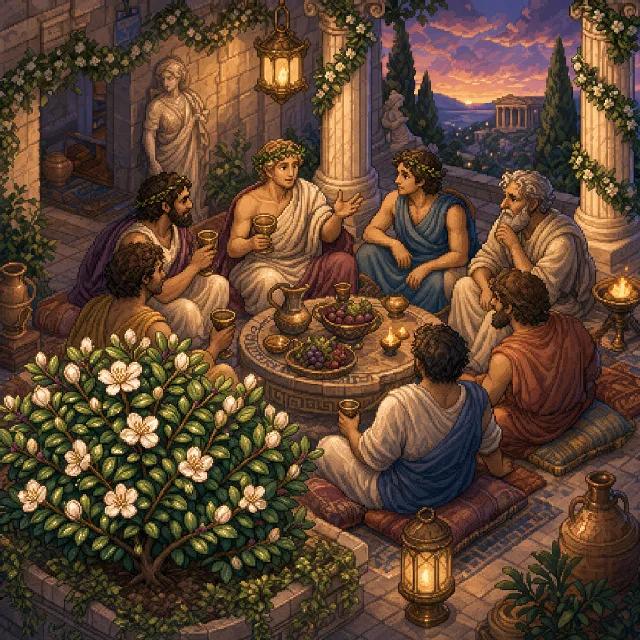
Symposium
Plato's dialogue on love, beauty, desire, and philosophical ascent.
About this book
The Symposium gathers speeches in praise of love, moving from comedy and myth toward Socrates' account of desire as a ladder from bodily attraction to the vision of beauty itself. The dialogue is playful, dramatic, and philosophically rich. It asks why love unsettles us, what it reveals about lack and aspiration, and how desire might become a path toward wisdom.
How do you want to read?
- Dialogue, Part 13353 words
As Apollodorus begins his tale, we step into a banquet where love itself is the guest of honor. The stage is set for a series of speeches, each vying to capture the nature of this ancient god.
- Dialogue, Part 23451 words
As the symposium continues, Pausanias takes the floor to refine the praise of Love, arguing that not all love is worthy of honor. He distinguishes between a common, physical love and a heavenly, intellectual one, setting the stage for a deeper exploration.
- Dialogue, Part 34318 words
As the symposium continues, Aristophanes and Agathon take their turns praising Love. Their speeches offer contrasting visions—one rooted in myth, the other in poetic celebration—each revealing a different facet of love's power.
- Dialogue, Part 44138 words
Socrates continues his inquiry into love, now guided by the teachings of Diotima. He prepares to reveal a deeper understanding of love's nature and purpose.
- Dialogue, Part 54139 words
Diotima's discourse reaches its peak as she unveils the ultimate vision of beauty—eternal and unchanging. But before the lesson can settle, a sudden commotion at the door heralds a very different kind of truth.
- Dialogue, Part 61680 words
Alcibiades, flushed with wine, takes up the challenge to praise Socrates. His speech will be no polished encomium but a series of vivid, personal anecdotes that reveal the philosopher's extraordinary nature.
- Dialogue, Part 13353 words
- Dialogue, Part 1738 words
As the company settles after supper, the conversation turns to a grand proposal: each guest will praise the god of love. Phaedrus, eager to begin, sets the stage with an ancient and noble account of Love's origins and power.
- Dialogue, Part 2741 words
In this chapter, two speakers deepen the inquiry into love's nature. Pausanias distinguishes a noble love from a base one, while Eryximachus expands the concept to medicine, music, and the cosmos, setting the stage for a broader understanding.
- Dialogue, Part 3992 words
Two more speakers take the floor, each offering a unique vision of Love. One tells a myth of our original wholeness, the other praises Love as the youngest and most beautiful god. Their words set the stage for a surprising turn.
- Dialogue, Part 4355 words
In this chapter, Socrates draws from Diotima's wisdom to reveal love's true nature—not a god but a spirit, born of poverty and plenty, ever seeking what it lacks.
- Dialogue, Part 5819 words
Diotima's ladder of love leads the soul from physical beauty to the eternal Form. But before the vision settles, a drunken Alcibiades bursts in, ready to praise—and expose—Socrates in his own way.
- Dialogue, Part 6370 words
Alcibiades continues his praise of Socrates, recounting tales of his extraordinary endurance and unique character. His speech builds toward a startling comparison that reveals the hidden depth beneath Socrates' humble exterior.
- Dialogue, Part 1738 words
- The Many Faces of Love1317 words
As the symposium continues, Pausanias takes the floor to refine the praise of Love, arguing that not all love is worthy of honor.
- The Many Faces of Love1317 words
Related works
Methodological kin
- Phaedo
Het Symposium wordt ernstiger naast de Phaedo: liefde en dood blijken twee wegen waarop de ziel boven het gewone uit wil.
- The Republic
Beide werken denken via gesprek en opstijging: in het Symposium naar liefde en schoonheid, in de Republiek naar rechtvaardigheid en het goede.