Phaedo
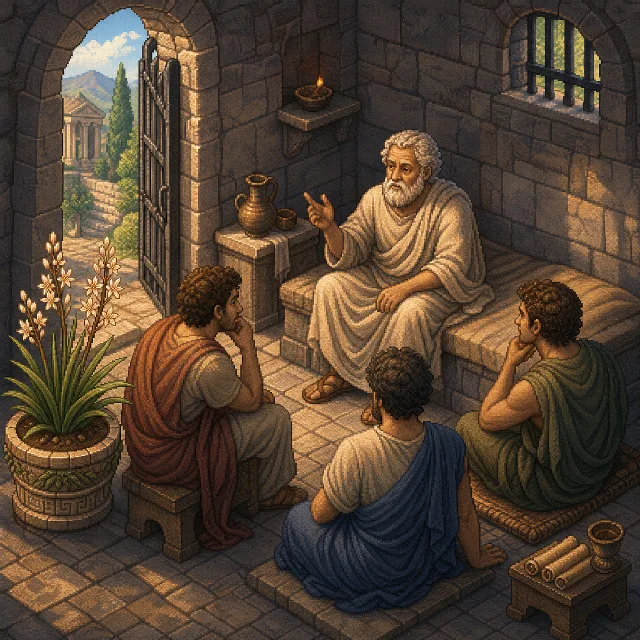
Phaedo
Plato's dialogue on death, the soul, and philosophy as preparation.
About this book
Phaedo presents Socrates on the day of his death, speaking with friends about the soul's immortality and the philosopher's relation to dying. The dialogue combines argument, myth, tenderness, and courage. It asks whether philosophy can train a person to let go of the body without despising life, and whether reason can face death without denial.
How do you want to read?
- Dialogue, Part 15019 words
The scene is set in Socrates' prison cell, where his friends gather on his final day. As they wait, the conversation turns to the nature of death and the philosopher's proper attitude toward it.
- Dialogue, Part 24533 words
As Socrates faces his final hours, he turns the conversation to the soul's nature and the philosopher's attitude toward death. He argues that true wisdom requires detachment from the body, making death not an end but a liberation.
- Dialogue, Part 34052 words
Socrates continues his argument for the soul's immortality, addressing the fear that the soul might be scattered after death. He distinguishes between the visible, changing body and the invisible, unchanging soul.
- Dialogue, Part 44506 words
As the discussion deepens, Cebes raises a fresh doubt about the soul's immortality, comparing it to a weaver who outlives many coats but eventually perishes. Socrates listens calmly, ready to address this new challenge.
- Dialogue, Part 54438 words
Socrates traces his intellectual journey, from youthful confidence in simple explanations to a profound disappointment with Anaxagoras. He sought a cause that would reveal what is best, but found only mechanical accounts.
- Dialogue, Part 64555 words
Socrates seals his final argument for the soul's immortality, declaring it imperishable. With Cebes convinced, he turns to the moral stakes: how we live now shapes our eternity.
- Dialogue, Part 7860 words
As the final hour approaches, Socrates faces his death with unwavering calm. This chapter recounts the moments leading to his end, revealing the depth of his philosophy in action.
- Dialogue, Part 15019 words
- Dialogue, Part 1888 words
On Socrates' final day, he speaks with friends about death and the soul. As he prepares to drink poison, he argues that true philosophers should welcome death as a release from the body's distractions.
- Dialogue, Part 21034 words
Socrates prepares to defend the philosopher's attitude toward death, arguing that true wisdom lies in separating soul from body. He begins with an ancient doctrine that souls exist after death, setting the stage for a deeper inquiry.
- Dialogue, Part 3939 words
Socrates continues his argument for the soul's immortality, addressing the fear that the soul might be scattered after death. He distinguishes between the visible, changing body and the invisible, unchanging soul, aligning the soul with the divine.
- Dialogue, Part 41032 words
As the dialogue deepens, Cebes introduces a subtle challenge to the soul's immortality. Socrates, aware of the stakes, warns against the danger of misology before addressing the arguments of his companions.
- Dialogue, Part 5935 words
Socrates shifts from physical explanations to a deeper inquiry into causes, seeking a secure foundation for understanding the soul. He prepares to argue that the soul, by its very nature, cannot admit death.
- Dialogue, Part 61098 words
Socrates concludes his final proof of the soul's immortality, then turns to describe the fate of souls after death. He paints a vivid picture of the underworld and the rewards of virtue.
- Dialogue, Part 7230 words
In this chapter, Socrates faces his final moments with calm resolve. His words and actions reveal a man at peace, even as his friends struggle with grief.
- Dialogue, Part 1888 words
- The Philosopher's Attitude Toward Death576 words
On his final day, Socrates sits in a prison cell, newly freed from chains. As friends gather, he turns their sorrow toward a deeper question: why should a wise person not fear death?
- Immortality and the Moral Life638 words
Cebes raises a fresh doubt about the soul's immortality, comparing it to a weaver who outlives many coats but eventually perishes. Socrates listens calmly, ready to address this new challenge.
- The Philosopher's Attitude Toward Death576 words
Related works
Maybe next
- Apology
De Phaedo krijgt zijn volle gewicht na de Apologie: de verdediging van het onderzochte leven eindigt in de oefening om kalm te sterven.
Methodological kin
- Symposium
De Phaedo laat filosofie oefenen in sterven; het Symposium laat haar opstijgen via liefde. Beide dialogen bewegen naar een hoger object.