The Consolation of Philosophy
The Consolation of Philosophy
A prison dialogue on fortune, suffering, providence, and true happiness.
About this book
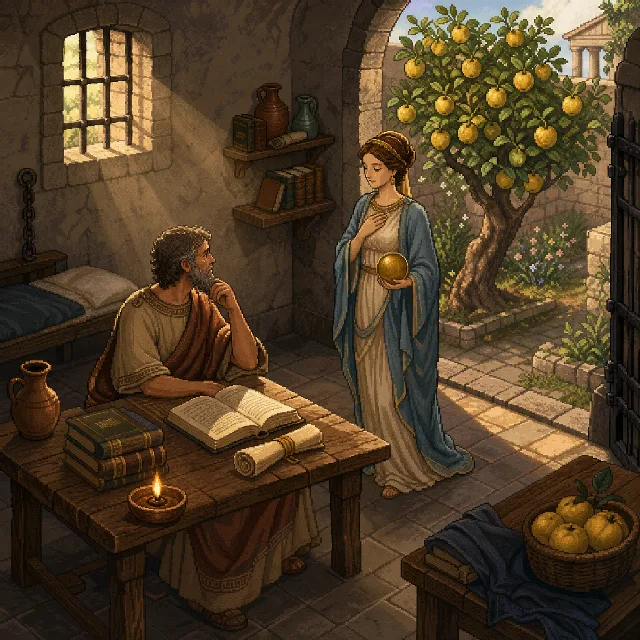
Written while Boethius awaited execution, The Consolation of Philosophy stages a conversation between the prisoner and Lady Philosophy. She teaches him to look beyond fortune's turning wheel toward goods that cannot be taken away. The book stands between antiquity and the Middle Ages, joining Stoic, Platonic, and Christian resonances in a severe but strangely consoling meditation on loss.
How do you want to read?
- Book 01, Part 14304 words
In a prison cell, Boethius mourns his fallen fortune. As he writes his sorrow, a majestic woman appears—Philosophy herself, ready to challenge his despair and the false comforts of poetry.
- Book 01, Part 21451 words
Lady Philosophy begins to diagnose Boethius's despair, tracing it to a forgetfulness of his true homeland and divine governance. She prepares to apply gentle remedies before stronger ones.
- Book 02, Part 14375 words
As the chapter opens, Philosophy gently prepares the prisoner to see Fortune's true nature. She argues that Fortune's constancy lies in her very changeability, and that happiness cannot be found in such fleeting gifts.
- Book 02, Part 23047 words
Philosophy continues her argument, challenging the value of wealth, power, and fame. She insists that true good cannot harm its possessor and that human worth comes from within, not from external possessions.
- Book 03, Part 14461 words
Philosophy now turns from false goods to true happiness. She argues that all humans seek happiness but are misled by wealth, rank, power, glory, and pleasure, which cannot truly satisfy.
- Book 03, Part 24625 words
Having seen the emptiness of wealth, power, and pleasure, Philosophy now unveils the nature of true happiness. She shows that it is a simple, unified good—nothing less than God himself.
- Book 03, Part 32379 words
Boethius now sees that all things naturally strive for the good, which is unity and God. Philosophy deepens this insight, showing how even plants and inanimate objects seek their own preservation and oneness.
- Book 04, Part 14463 words
Boethius presses Philosophy on the deepest riddle: why evil thrives while good suffers. She promises to reveal the hidden order behind apparent chaos, preparing to show that all fortune serves a just purpose.
- Book 04, Part 24383 words
Philosophy now deepens her argument, showing that every fortune—even punishment—serves a just purpose. She challenges the narrator to see that the wicked are always punished by their own vice, and that true justice lies in the soul's health.
- Book 04, Part 3485 words
Philosophy prepares us for life's trials, insisting they are not punishments but opportunities. As we explore this chapter, consider how adversity might forge virtue rather than destroy it.
- Book 05442 words
This chapter tackles the ancient puzzle of free will versus divine foreknowledge. Boethius and Philosophy explore whether God's certain knowledge of future events can coexist with genuine human choice, setting the stage for a profound resolution.
- Book 01, Part 14304 words
- Book 01, Part 1974 words
In this chapter, we meet Boethius in his prison cell, overwhelmed by grief and injustice. A mysterious woman appears, rebuking the Muses of poetry and beginning a dialogue that will challenge his despair.
- Book 01, Part 2363 words
Boethius believes himself exiled and wretched, but Lady Philosophy reveals his true exile is self-imposed. She gently begins to restore his memory of his homeland and his own nature, preparing him for deeper remedies.
- Book 02, Part 1980 words
Fortune's nature is changeable, and her gifts are fleeting. Philosophy begins to reveal that true happiness cannot depend on such unstable things.
- Book 02, Part 2665 words
Philosophy now turns to question the value of wealth, power, and fame. Through sharp arguments, it reveals how these pursuits often harm rather than help. The dialogue challenges us to reconsider what truly constitutes a good life.
- Book 03, Part 11023 words
As we explore the nature of happiness, Philosophy guides us to examine common pursuits. Are wealth, power, and glory truly fulfilling? Prepare to see these false goods stripped of their appeal.
- Book 03, Part 21036 words
Having exposed the emptiness of false happiness, Philosophy now turns to reveal the nature of true happiness. She argues that it must be perfect and unified, leading to a startling conclusion.
- Book 03, Part 3519 words
As the chapter unfolds, Boethius explores how all things naturally seek the good, linking this desire to unity and God. Prepare to see how this leads to a profound conclusion about the nature of evil.
- Book 04, Part 1912 words
Boethius questions how evil can exist under a good ruler. Philosophy begins to unravel this mystery, promising to show that justice always prevails.
- Book 04, Part 2993 words
Philosophy now draws her argument to a close, revealing that all fortune serves a hidden order. Though the world seems chaotic, every event is guided toward the soul's true good. Prepare to see how even hardship becomes a gift.
- Book 04, Part 3139 words
This chapter explores the Stoic view of adversity as a forge for virtue. Philosophy argues that wise men should welcome fortune's trials like soldiers welcome battle, for hardship perfects character.
- Book 05128 words
Can freedom coexist with divine foreknowledge? This chapter explores the apparent paradox, examining how God's eternal perspective does not impose necessity on human choices.
- Book 01, Part 1974 words
- The Consolation of Philosophy: Fortune and True Happiness707 words
Boethius, imprisoned and grieving, is visited by Lady Philosophy. She diagnoses his despair as forgetfulness of his true home and divine order. Gently, she begins to heal him by revealing Fortune's true nature.
- The Consolation of Philosophy: Providence, Evil, and Free Will1170 words
In this chapter, Boethius presses Philosophy on why evil thrives while good suffers. She promises to reveal the hidden order, showing that all fortune-even punishment-serves a just purpose.
- The Consolation of Philosophy: Fortune and True Happiness707 words
Related works
Later works building on this
- City of God: A Coltiva Selection
Boethius sluit aan bij de late antieke vraag naar ramp en bestendigheid: na Augustinus wordt filosofische troost persoonlijk en gevangenisachtig.
- Meditations
Boethius leest als een late erfgenaam van de stoicijnse vraag: wat blijft van de mens over wanneer Fortuna alles afneemt?
Earlier works
- Divine Comedy - Inferno
Boethius krijgt een groot middeleeuws vervolg in Dante: filosofische troost wordt reis door schuld, straf en ordening.