City of God: A Coltiva Selection
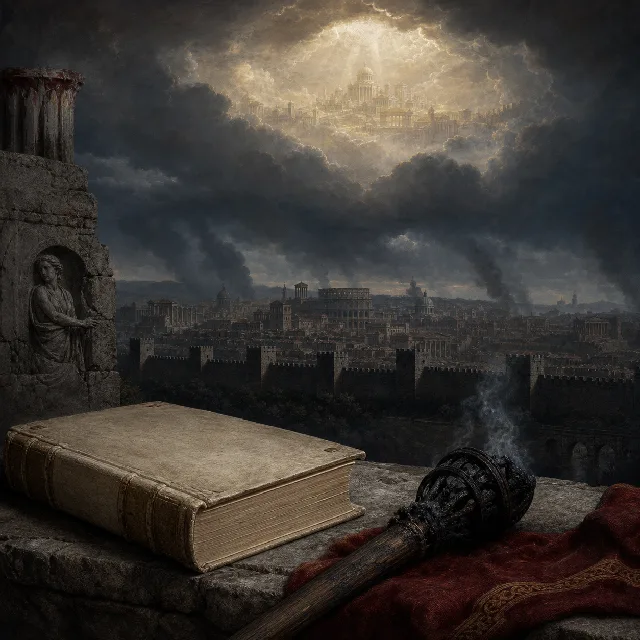
City of God: A Coltiva Selection
Augustine on Rome, history, worship, and the two cities.
About this book
City of God was Augustine's answer to a shaken world after the sack of Rome. This selection follows his argument that no earthly empire can carry the weight of ultimate hope. Against pagan nostalgia and political despair, Augustine distinguishes the earthly city from the city of God, asking how love, worship, justice, and history shape the destiny of human communities.
How do you want to read?
- PREFACE, EXPLAINING HIS DESIGN IN UNDERTAKING, Part 14150 words
Augustine opens his great work by addressing Marcellinus, setting the stage for a defense of the heavenly city against its earthly critics. He prepares to examine why the good and wicked suffer alike, and how divine mercy shone even in Rome's fall.
- PREFACE, EXPLAINING HIS DESIGN IN UNDERTAKING, Part 24510 words
In this chapter, we explore why good people suffer alongside the wicked in temporal calamities. The discussion examines motives for withholding rebuke, the proper attitude toward earthly possessions, and the spiritual benefits of trials.
- PREFACE, EXPLAINING HIS DESIGN IN UNDERTAKING, Part 34545 words
This chapter explores the nature of true virtue and its resilience in the face of bodily harm, using the examples of Regulus and violated Christian captives to challenge pagan criticisms.
- PREFACE, EXPLAINING HIS DESIGN IN UNDERTAKING, Part 44520 words
Augustine continues his argument against suicide, contrasting the Roman hero Cato with the captive Regulus to show that self-inflicted death is never justified. He then addresses the sensitive case of Christian women who were raped during the sack of Rome.
- PREFACE, EXPLAINING HIS DESIGN IN UNDERTAKING, Part 5795 words
This chapter explores the intertwined fates of the earthly and heavenly cities, using Rome's founding myth to illuminate how good and evil coexist within the church and world.
- City Of God Selection City Of God Book Second, Part 14070 words
Augustine now turns to the moral failures of pagan worship, arguing that the gods themselves promoted vice. He challenges the Romans to examine their own history and see that their gods never provided laws for virtuous living.
- City Of God Selection City Of God Book Second, Part 24262 words
This chapter explores how the Greeks and Romans treated actors and poets, revealing deep contradictions in their religious and civic values. Their gods demanded theatrical honors, yet their laws often scorned the performers. These tensions set the stage for a Christian critique of pagan worship.
- City Of God Selection City Of God Book Second, Part 34616 words
Augustine now turns to the Roman republic's moral decay, citing Roman authors to show it was corrupt long before Christ. He challenges the pagans who blame Christianity for Rome's troubles, arguing their own gods failed to provide moral guidance.
- City Of God Selection City Of God Book Second, Part 43336 words
In this chapter, we examine how the Romans' own gods, through omens and spectacles, encouraged the very vices that led to the republic's moral decay. The narrative challenges the claim that Christianity caused Rome's decline, instead pointing to the corrupting influence of traditional worship.
- City Of God Selection City Of God Book Third, Part 14521 words
Augustine turns from moral to physical calamities, arguing that Rome's false gods failed to prevent war, famine, and disaster even when worshipped exclusively. He challenges the notion that divine favor secured Roman prosperity.
- City Of God Selection City Of God Book Third, Part 24406 words
Augustine continues his critique of Roman religion by examining the city's early history. He questions whether the multitude of gods protected Rome from the moral and physical disasters that marked its founding and expansion.
- City Of God Selection City Of God Book Third, Part 33924 words
Augustine continues his historical survey, arguing that even during Rome's so-called best period, the republic suffered continuous disasters, proving the gods could not secure temporal happiness.
- City Of God Selection City Of God Book Third, Part 43689 words
Augustine continues his historical survey, now focusing on the period of Rome's greatest virtue and harmony, yet even then, he finds disasters that undermine the claim that pagan gods protected Rome.
- City Of God Selection City Of God Book Third, Part 5763 words
In this chapter, Augustine challenges critics who blame Christianity for disasters, arguing that similar calamities occurred before Christ. He cites historical examples to show that pagan worship did not prevent catastrophe.
- City Of God Selection City Of God Book Fourth, Part 14507 words
This chapter examines whether the Roman empire's greatness came from their many gods or the one true God. Augustine contrasts true felicity with earthly power, questioning the value of empire without justice.
- City Of God Selection City Of God Book Fourth, Part 22823 words
Augustine continues his critique of pagan polytheism, questioning the logic of dividing divine attributes among many gods. He challenges the coherence of a system where gods overlap or contradict each other, setting the stage for a deeper examination of their worship.
- City Of God Selection City Of God Book Fourth, Part 33845 words
Augustine continues his critique of Roman religion, arguing that Virtue and Felicity are gifts of God, not goddesses. He challenges the logic of worshipping these as deities while ignoring the true Giver.
- City Of God Selection City Of God Book Fourth, Part 44097 words
This chapter examines the Roman distinction between three kinds of gods-poetic, philosophical, and civic-and reveals how even their own thinkers doubted the state religion.
- Book iii185 words
This chapter gathers a list of references from scripture, classical literature, and history. It begins with a brief observation on the etymology of 'consul' and then presents a sequence of citations without commentary.
- City Of God Selection City Of God Book Nineteenth, Part 14529 words
In this chapter, Augustine examines philosophical views on the supreme good, contrasting them with the Christian hope of eternal life. He begins by analyzing Varro's classification of 288 possible philosophical sects.
- City Of God Selection City Of God Book Nineteenth, Part 24259 words
This chapter examines the human condition through the lens of virtue, arguing that even the best qualities reveal life's deep miseries. It questions whether true happiness can exist amid perpetual inner conflict and societal ills.
- City Of God Selection City Of God Book Nineteenth, Part 34445 words
In this chapter, Augustine explores the universal desire for peace, showing how even conflict and war are ultimately aimed at achieving it. He argues that peace is the natural end of all beings, from the lowest to the highest.
- City Of God Selection City Of God Book Nineteenth, Part 44446 words
Augustine now examines the origin of slavery, arguing it is a consequence of sin, not nature. He then contrasts earthly peace with the eternal peace of the heavenly city, leading to a final judgment on whether Rome ever truly qualified as a republic.
- City Of God Selection City Of God Book Nineteenth, Part 54141 words
Augustine examines Porphyry's conflicting oracles about Christ, then redefines what constitutes a people. He argues that true justice and peace depend on a shared love of God, setting the stage for his contrast between the earthly and heavenly cities.
- PREFACE, EXPLAINING HIS DESIGN IN UNDERTAKING, Part 14150 words
- PREFACE, EXPLAINING HIS DESIGN IN UNDERTAKING, Part 1958 words
In this opening chapter, Augustine sets the stage for a monumental defense of the Christian faith, addressing the charge that Christianity caused Rome's fall. He contrasts the earthly city's lust for power with the heavenly city's humble devotion.
- PREFACE, EXPLAINING HIS DESIGN IN UNDERTAKING, Part 2846 words
This chapter explores why good people suffer alongside the wicked, examining motives for silence and the deeper purposes of affliction.
- PREFACE, EXPLAINING HIS DESIGN IN UNDERTAKING, Part 31058 words
Chapter 3 examines the nature of virtue and purity, arguing that bodily violation does not taint a chaste soul. It challenges the logic of suicide as a response to dishonor, using Regulus and Lucretia as contrasting examples.
- PREFACE, EXPLAINING HIS DESIGN IN UNDERTAKING, Part 4912 words
Augustine continues his argument against suicide, contrasting Roman heroes and defending Christian women. He challenges the logic of self-inflicted death, even to preserve chastity, and questions why Christians complain of calamities that serve divine correction.
- PREFACE, EXPLAINING HIS DESIGN IN UNDERTAKING, Part 5164 words
This chapter explores how Rome's founders welcomed all, even criminals, to build their city-a pattern that echoes in Christ's own offer of refuge.
- City Of God Selection City Of God Book Second, Part 1802 words
Augustine turns to examine Rome's moral state before Christ, questioning why the pagan gods failed to improve conduct. He argues that their worship encouraged vice rather than virtue, setting the stage for a deeper critique.
- City Of God Selection City Of God Book Second, Part 2967 words
This chapter contrasts Greek and Roman attitudes toward actors and poets, exploring how each culture's treatment of the stage reflects deeper beliefs about the gods and civic honor.
- City Of God Selection City Of God Book Second, Part 31064 words
Augustine turns to Roman authors themselves to show the republic's moral decay before Christ, arguing that the pagan gods failed to provide moral guidance. He contrasts this with Christian teachings, setting the stage for his claim that true justice belongs only to the City of God.
- City Of God Selection City Of God Book Second, Part 4748 words
In this chapter, Augustine examines how the demons' own rites reveal their corrupt nature. He contrasts their public obscenities with secret moral precepts, questioning their authority.
- City Of God Selection City Of God Book Third, Part 1896 words
Augustine shifts from moral evils to physical disasters, arguing that Rome's gods failed to prevent them even when most worshipped. He examines Troy's fall and Roman history to expose divine impotence.
- City Of God Selection City Of God Book Third, Part 2887 words
Rome's many gods did not prevent its early wars and political crimes. This chapter examines the Sabine women episode, the Alban war, and the violent ends of Roman kings, questioning the gods' protection.
- City Of God Selection City Of God Book Third, Part 3891 words
Augustine turns to Roman history to test the claim that the old gods secured temporal happiness. He cites Sallust and a litany of disasters, asking where the gods were when each calamity struck.
- City Of God Selection City Of God Book Third, Part 4846 words
Augustine continues his historical survey, now focusing on Roman civil wars and internal strife before Christ. He argues these disasters, far worse than foreign invasions, occurred under the pagan gods' watch, challenging their supposed protection.
- City Of God Selection City Of God Book Third, Part 5188 words
As we explore the argument that disasters are unfairly blamed on Christians, consider how history might have judged differently if Christianity had come earlier.
- City Of God Selection City Of God Book Fourth, Part 11024 words
This chapter examines the nature of earthly kingdoms and the true source of their rise and fall. It questions the glory of empire when happiness is absent, and challenges the role of Roman gods in Rome's expansion.
- City Of God Selection City Of God Book Fourth, Part 2603 words
Augustine continues his critique of pagan polytheism, probing the logical inconsistencies in dividing divine powers among many gods. He challenges the necessity of multiple deities if one god could encompass all functions.
- City Of God Selection City Of God Book Fourth, Part 3902 words
Augustine challenges the Roman deification of Virtue and Felicity, arguing they are gifts from the one true God, not goddesses. He exposes the absurdity of worshipping the gifts while ignoring the Giver.
- City Of God Selection City Of God Book Fourth, Part 4945 words
This chapter examines Roman theological distinctions and critiques of polytheism, revealing how even their own thinkers doubted the gods. It sets the stage for contrasting false worship with the one true God.
- Book iii68 words
This chapter explores the etymology of 'consul' and its implications for governance. Augustine contrasts it with terms like 'rex' and 'dominus', drawing on scripture and classical sources.
- City Of God Selection City Of God Book Nineteenth, Part 11018 words
As we approach the final book, Augustine turns to the ultimate ends of the two cities, contrasting earthly philosophies with the hope of eternal blessedness.
- City Of God Selection City Of God Book Nineteenth, Part 2999 words
This chapter examines virtue's role in human life, questioning whether even the wisest can escape inner conflict. It explores how virtues like prudence, fortitude, and temperance engage with suffering, setting the stage for a deeper inquiry into the nature of true happiness.
- City Of God Selection City Of God Book Nineteenth, Part 3984 words
This chapter explores the universal longing for peace, even among those who wage war. It examines how true peace is found not in earthly security but in the eternal order of God's city.
- City Of God Selection City Of God Book Nineteenth, Part 4891 words
Augustine traces the origin of slavery to sin, not nature, and explores how earthly peace relates to the eternal peace of the heavenly city. He then tests Rome's claim to be a true republic.
- City Of God Selection City Of God Book Nineteenth, Part 5973 words
Augustine confronts Porphyry's oracles, exposing their contradictions and demonic origin. He then redefines what constitutes a people, shifting the focus from political institutions to shared objects of love.
- PREFACE, EXPLAINING HIS DESIGN IN UNDERTAKING, Part 1958 words
- The Justice of God in the Fall of Rome1091 words
As Rome reels from the barbarian sack, bitter accusations arise against the Christian faith. The pagans blame Christ for the city's fall, but a closer look reveals a different story-one of unexpected mercy and deeper purpose.
- The Moral Failure of Pagan Gods1340 words
In this chapter, Augustine argues that Rome's moral decay predates Christianity, blaming the pagan gods for failing to provide moral laws and even encouraging vice through their own worship.
- The Inability of Pagan Gods to Prevent Calamities1404 words
Augustine argues that Rome's pagan gods failed to prevent even the worst calamities, from Troy's fall to civil wars. He challenges the notion that these gods ever secured peace or prosperity, using Roman history itself as evidence.
- True Justice and Peace in the City of God1206 words
Augustine turns from the miseries of earthly life to the nature of true peace. He argues that all people desire peace, yet only in the City of God is it found perfectly, ordered under God.
- The Justice of God in the Fall of Rome1091 words
Related works
Thematic kin
- Selected Homilies
City of God krijgt een pastorale tegenstem naast Chrysostomus: dezelfde spanning tussen geloof, stad en rijk, maar in een ander register.
Later works building on this
- Summa Theologiae: A Coltiva Selection
Augustinus geeft een groot raamwerk voor vrede, ordening en de twee steden; Aquinas werkt later preciezer aan wet, rechtvaardigheid en handelen.
- The Consolation of Philosophy
Augustinus denkt na Rome over aardse en hemelse steden; Boethius schrijft later in politieke ondergang over Fortuna en wat werkelijk goed blijft.