A Vindication of the Rights of Woman
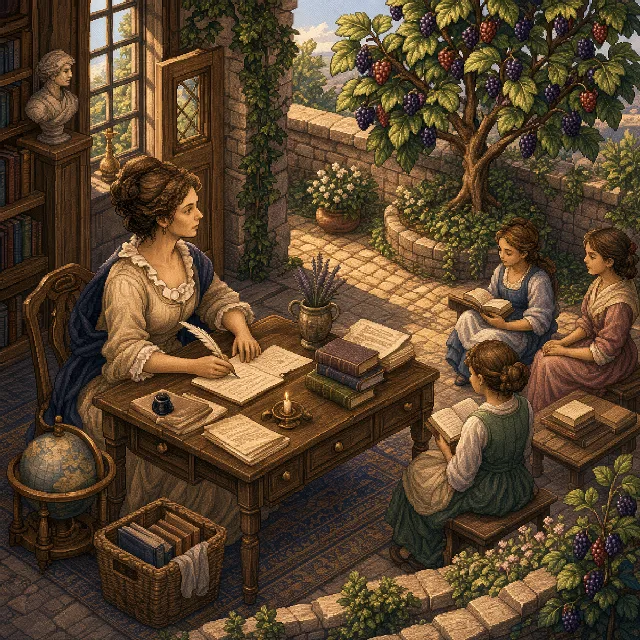
A Vindication of the Rights of Woman
Wollstonecraft's argument for women's reason, education, dignity, and citizenship.
About this book
A Vindication of the Rights of Woman attacks a society that trains women for dependence and then calls that dependence natural. Wollstonecraft argues that women are rational beings whose education must prepare them for virtue, judgment, motherhood, friendship, and citizenship. The book is forceful because it links private formation to public justice: no society can be free while half its members are educated for weakness.
How do you want to read?
- Dedication1717 words
Wollstonecraft opens her dedication with a respectful yet firm appeal to Talleyrand, challenging him to reconsider women's exclusion from education and political rights. She frames her argument as a plea for humanity, not personal gain.
- Introduction1923 words
As this chapter unfolds, Wollstonecraft challenges the foundations of women's education, arguing that society's focus on beauty over reason has weakened them. She prepares to lay out her vision for a more rational and empowering approach.
- Chapter 01 Rights And Duties2854 words
This chapter challenges us to strip away prejudice and return to first principles. Wollstonecraft insists that reason and virtue define human worth, setting the stage for a critique of society's corruptions.
- Chapter 02 Sexual Character, Part 14632 words
In this chapter, Wollstonecraft dissects the idea that women require a different virtue than men. She argues this notion is a pretext for tyranny, keeping women in ignorance. Prepare to see her challenge Milton and Rousseau, asserting that true virtue demands the exercise of reason.
- Chapter 02 Sexual Character, Part 23889 words
Wollstonecraft challenges women to abandon artifice and cultivate reason, arguing that true companionship in marriage rests on friendship, not fleeting love.
- Chapter 03 Same Subject Continued, Part 14508 words
As we continue exploring Wollstonecraft's arguments, this chapter challenges the notion that women's physical weakness is natural, urging a reexamination of how society cultivates such traits.
- Chapter 03 Same Subject Continued, Part 21563 words
As this chapter unfolds, Wollstonecraft sharpens her critique of women's education. She contrasts two paths: one leading to dependence and ruin, the other to resilience and virtue. The stakes are nothing less than a woman's capacity to stand alone.
- Chapter 04 State Of Degradation, Part 12586 words
In this chapter, Wollstonecraft sharpens her critique of how society degrades women by denying them reason. She draws a provocative parallel between women and the idle rich, arguing both are confined to superficial pursuits.
- Chapter 04 State Of Degradation, Part 24467 words
This chapter challenges the notion that women are naturally suited only for feeling, arguing instead that reason is essential for virtue and duty.
- Chapter 04 State Of Degradation, Part 32633 words
Wollstonecraft continues her critique by examining how society's narrow definition of female honor—reduced to chastity—leads to moral degradation and dependence.
- Chapter 05 Writers On Women, Part 14588 words
Wollstonecraft turns her critical eye to Rousseau's influential ideas on female education, laying bare the assumptions that underpin his prescriptions.
- Chapter 05 Writers On Women, Part 24532 words
In this chapter, Wollstonecraft continues her critique of Rousseau, examining his advice to women and exposing its contradictions. She argues that such teachings undermine women's reason and perpetuate their subordination.
- Chapter 05 Writers On Women, Part 34468 words
Wollstonecraft turns her critical eye on popular advice for women, exposing how it enforces dissimulation and subordination. She argues that true virtue requires reason and sincerity, not calculated performances.
- Chapter 05 Writers On Women, Part 43163 words
In this chapter, Wollstonecraft challenges the notion that education should merely instill worldly prudence. Instead, she argues for a more natural development, where the mind grows through experience and the struggle with passions, much like a tree allowed to weather storms.
- Chapter 06 Early Association Of Ideas2539 words
This chapter explores how early associations shape character, especially in women's education. Wollstonecraft argues that these habits of mind can enslave or liberate, depending on whether reason intervenes.
- Chapter 07 Modesty4435 words
In this chapter, Wollstonecraft refines the concept of modesty, distinguishing it from humility and bashfulness. She argues that true modesty is a virtue of reason and self-respect, not a gendered trait.
- Chapter 08 Morality And Reputation4307 words
In this chapter, Wollstonecraft dissects how society's obsession with women's reputation for chastity corrupts true virtue. She argues that this focus on appearances leads to hypocrisy and moral decay, setting the stage for a deeper critique of gender roles.
- Chapter 09 Unnatural Distinctions Part 12258 words
As Wollstonecraft deepens her critique of property and wealth, she turns to their specific impact on women. This chapter examines how dependence and the pursuit of beauty corrupt virtue, setting the stage for a powerful argument about the need for female independence.
- Chapter 09 Unnatural Distinctions Part 22364 words
Wollstonecraft builds her case for women's independence, arguing that their first duty is to themselves as rational beings and citizens. She challenges societal norms that confine them to domestic roles, setting the stage for a radical call to action.
- Chapter 10 Parental Affection1086 words
Wollstonecraft challenges the notion of parental affection, arguing it often masks tyranny. She insists that women, lacking education, fail as rational mothers. This chapter explores how power corrupts even the most intimate bonds.
- Chapter 11 Duty To Parents2151 words
This chapter examines the foundation of parental authority, arguing it should rest on reason and mutual duty, not blind obedience. It warns against the arbitrary exercise of power, especially over girls, and its harmful effects on the mind.
- Chapter 12 National Education, Part 14524 words
In this chapter, Wollstonecraft turns to national education, arguing that private schooling alone cannot foster true citizens. She envisions a system blending public and private elements, where children learn both domestic affections and civic virtue.
- Chapter 12 National Education, Part 24480 words
Wollstonecraft argues that women's cunning stems from oppression, not nature. She proposes a bold solution: national coeducation, where boys and girls learn together from an early age. This chapter outlines her detailed plan for such schools.
- Chapter 12 National Education, Part 31105 words
This chapter challenges the prejudice against learned women, arguing that educating women in anatomy and medicine would make them better mothers. Wollstonecraft contends that such knowledge is essential for the welfare of children and society.
- Chapter 13 Folly From Ignorance, Part 14579 words
In this chapter, Wollstonecraft turns her attention to the follies that arise from women's ignorance, particularly credulity and an excessive concern with appearance. She challenges readers to examine their own beliefs and practices.
- Chapter 13 Folly From Ignorance, Part 22729 words
Wollstonecraft argues that women's narrow affections stem from confinement, not nature. She contends that education and freedom would expand their hearts and minds, challenging the assumption of female inferiority.
- Dedication1717 words
- Dedication399 words
Wollstonecraft opens with a dedication to Talleyrand, challenging his views on education. She sets the stage for her argument that women's rights are essential to progress.
- Introduction398 words
Chapter 2 opens with Wollstonecraft's bold claim that women's misery stems from a flawed education. She argues that society's focus on beauty over strength weakens women, urging them to cultivate both mind and body.
- Chapter 01 Rights And Duties645 words
In this chapter, Wollstonecraft grounds human worth in reason and virtue, then challenges Rousseau's idealized state of nature. She prepares to expose how inherited power and professional hierarchies corrupt society.
- Chapter 02 Sexual Character, Part 11039 words
In this chapter, Wollstonecraft challenges the idea that women have a distinct virtue, arguing that such notions serve tyranny. She insists that true virtue requires reason, which must be cultivated through education.
- Chapter 02 Sexual Character, Part 2786 words
In this chapter, Wollstonecraft challenges the notion that women should feign weakness to secure affection, arguing instead for the cultivation of reason and virtue as the foundation of true companionship.
- Chapter 03 Same Subject Continued, Part 11021 words
In this chapter, Wollstonecraft challenges the notion that women's physical weakness is natural, arguing instead that society cultivates it. She calls for a revolution in female education to restore dignity through strength and reason.
- Chapter 03 Same Subject Continued, Part 2357 words
This chapter contrasts the fate of a woman trained only to please with one who cultivates her understanding. The stakes are independence and respect, but the path is not yet clear.
- Chapter 04 State Of Degradation, Part 1598 words
In this chapter, Wollstonecraft examines how women are degraded by societal expectations that deny them reason. She draws parallels between women and the aristocracy, arguing that both are confined to trivial pursuits that stifle intellectual growth.
- Chapter 04 State Of Degradation, Part 21014 words
This chapter challenges the notion that women's education should prioritize sensibility over reason. Wollstonecraft argues for intellectual cultivation as the foundation of virtue and independence.
- Chapter 04 State Of Degradation, Part 3530 words
This chapter explores how societal constraints and idle pursuits degrade women's character, reducing virtue to mere chastity. Wollstonecraft argues that limited education and superficial employments contract the mind, perpetuating dependence.
- Chapter 05 Writers On Women, Part 11029 words
In this chapter, Wollstonecraft turns her critical eye on Rousseau's influential views on female education. She prepares to dissect his arguments, revealing how they rest on shaky assumptions about women's nature.
- Chapter 05 Writers On Women, Part 21012 words
In this chapter, Wollstonecraft turns her critical eye to influential writers who shaped female education. She dissects their arguments, exposing how they undermine women's reason while praising their charms.
- Chapter 05 Writers On Women, Part 3931 words
This chapter challenges the advice that women should hide their intelligence, arguing instead for genuine virtue and reason. Wollstonecraft critiques the system of dissimulation that degrades women.
- Chapter 05 Writers On Women, Part 4709 words
As we watch our trees grow wild and strong, we consider the mind's slower path to perfection. This chapter explores whether education should shelter or expose, and how true wisdom emerges from struggle.
- Chapter 06 Early Association Of Ideas549 words
This chapter explores how early associations of ideas, especially in women's education, shape character and lead to dependence. Wollstonecraft argues that these habits, formed in youth, are hard to break without reason.
- Chapter 07 Modesty981 words
In this chapter, Wollstonecraft redefines modesty as a virtue of reason and self-respect, distinct from bashfulness or humility. She argues it must be cultivated equally by both sexes through knowledge and inner strength.
- Chapter 08 Morality And Reputation964 words
This chapter examines how society's focus on women's reputation for chastity can undermine genuine virtue. Wollstonecraft questions whether such emphasis truly serves morality or merely enforces appearances.
- Chapter 09 Unnatural Distinctions Part 1478 words
This chapter examines how property and wealth corrupt society, especially women, who are denied independence and forced to rely on personal charms. Wollstonecraft argues that virtue requires equality and the discharge of duties.
- Chapter 09 Unnatural Distinctions Part 2559 words
This chapter challenges the notion of women's dependence, arguing that true virtue and citizenship require independence. Wollstonecraft insists that women must first be rational beings, then citizens, before any other role.
- Chapter 10 Parental Affection261 words
This chapter scrutinizes the nature of parental affection, revealing how it can mask tyranny. Wollstonecraft argues that women, denied education, fail as rational mothers, making their own enlightenment essential.
- Chapter 11 Duty To Parents514 words
This chapter examines the foundation of parental authority, arguing it should rest on reason and mutual duty rather than blind obedience. It warns against the arbitrary exercise of power, especially over girls.
- Chapter 12 National Education, Part 1939 words
Wollstonecraft reconsiders private education's limits and proposes a national system of day schools. She argues that children need both domestic affections and equal society to become virtuous citizens.
- Chapter 12 National Education, Part 2939 words
This chapter presents Wollstonecraft's bold vision for national coeducation, arguing that shared schooling will foster virtue and equality between the sexes.
- Chapter 12 National Education, Part 3285 words
This chapter challenges the notion that women's ignorance is natural, arguing instead that it is a product of societal neglect. Wollstonecraft insists that education in anatomy and medicine is essential for women to fulfill their roles as mothers and citizens.
- Chapter 13 Folly From Ignorance, Part 1926 words
Wollstonecraft turns her critique toward women's follies, tracing them to ignorance. She challenges credulity in fortune-tellers and magnetisers, then examines sentimentalism and dress as symptoms of neglected reason.
- Chapter 13 Folly From Ignorance, Part 2606 words
In this chapter, Wollstonecraft challenges the notion that women's exclusive affections prove their inferiority, arguing instead that confinement and lack of education are to blame.
- Dedication399 words
- Foundations of Reason and Virtue1199 words
Wollstonecraft opens her argument with a respectful challenge to Talleyrand, urging him to reconsider women's exclusion from education and rights. She sets the stage for a rational plea for equality.
- Critique of Sexual Character and Education1461 words
Wollstonecraft dissects the idea that women require a different virtue than men. She argues this notion is a pretext for tyranny, keeping women in ignorance. Prepare to see her challenge Milton and Rousseau, asserting that true virtue demands the exercise of reason.
- Analysis of Influential Writers and Social Institutions1272 words
Having laid out general principles, Wollstonecraft now turns to specific writers who have shaped opinion on women. She begins with Rousseau, whose influential ideas on female education she will dissect.
- Proposal for National Education and Conclusion1466 words
Wollstonecraft reconsiders private education, arguing it breeds vanity and premature sophistication. She envisions a national system of day schools where children learn both domestic affections and civic virtue, laying the groundwork for her bold proposal.
- Foundations of Reason and Virtue1199 words
Related works
Methodological kin
- Declaration of the Rights of Woman and of the Female Citizen
Wollstonecraft bouwt een betoog over rede en opvoeding; De Gouges legt de politieke hypocrisie van universele rechten bloot.
Later works building on this
- On Liberty
Wollstonecrafts eis om vrouwen als redelijke wezens te behandelen loopt vooruit op Mill's bredere verdediging van individuele vrijheid.