The Praise of Folly
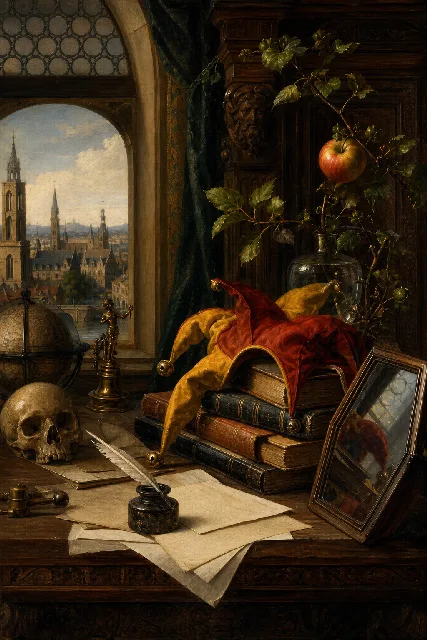
The Praise of Folly
Erasmus's brilliant satire of pride, learning, religion, and human foolishness.
About this book
The Praise of Folly lets Folly herself praise the absurdities that rule human life, from scholars and courtiers to theologians and churchmen. Erasmus uses laughter to expose vanity, pedantry, superstition, and self-importance, while leaving room for a gentler Christian wisdom. The book is playful, dangerous, and humane: it corrects by making pretension ridiculous.
How do you want to read?
- Gutenberg 9371, Part 14381 words
Erasmus sets the stage for a playful yet pointed satire, dedicating his mock encomium to his friend Thomas More. Folly herself takes the podium, ready to defend her divine influence over all human affairs.
- Gutenberg 9371, Part 24498 words
Folly continues her praise, arguing that she is the source of youth, pleasure, and social bonds. She contrasts the happiness of fools with the misery of the wise, claiming that without her, life would be unbearable.
- Gutenberg 9371, Part 34526 words
In this chapter, Folly argues that wisdom is a hindrance to practical life and that folly is essential for happiness and society. She uses vivid examples to show how foolishness enables human achievement and social order.
- Gutenberg 9371, Part 44646 words
Erasmus continues his praise of folly by arguing that fools are happier and more honest than the wise. He contrasts the simple, natural lives of fools with the troubled existence of learned men, setting the stage for a deeper exploration of madness and superstition.
- Gutenberg 9371, Part 55073 words
Folly continues her praise of self-love and flattery, arguing that opinion outweighs reality in making men happy. She illustrates this with examples from various nations and professions, showing how self-deception brings contentment.
- Gutenberg 9371, Part 64742 words
In this chapter, Folly turns her sharp wit on lawyers, logicians, philosophers, theologians, and monks, exposing their self-importance and empty disputes. She shows how they delight in trivialities while missing true wisdom.
- Gutenberg 9371, Part 74624 words
In this chapter, Folly turns her sharp wit toward theologians, princes, and clergy, exposing how their self-deception and love of absurdity make life bearable. She argues that wisdom would only bring misery, while folly secures pleasure and power.
- Gutenberg 9371, Part 84660 words
Folly now turns to Scripture, citing Ecclesiastes and Paul to argue that all mankind are fools and that folly is essential to Christianity. She prepares to defend her claims against learned critics.
- Gutenberg 9371, Part 91948 words
Erasmus, through the voice of Folly, now turns to the highest form of madness: Christian piety. He argues that the pursuit of spiritual happiness resembles divine folly, setting the stage for a provocative comparison between worldly wisdom and religious devotion.
- Gutenberg 9371, Part 14381 words
- Gutenberg 9371, Part 1954 words
As Erasmus dedicates his playful work to Thomas More, he sets the stage for Folly's own oration. She introduces her divine lineage and argues that folly is essential to life itself, promising a sharp yet humorous critique of human pretensions.
- Gutenberg 9371, Part 21017 words
Folly now turns to defend the foolishness of old age and childhood, claiming they are natural and beneficial. She argues that her influence keeps youth at bay and makes life pleasant, setting the stage for her broader claims about social bonds.
- Gutenberg 9371, Part 31037 words
Folly continues her praise, arguing that wisdom is useless in practical affairs. She challenges the ideal of the philosopher-king and defends the role of passion and pretense in human life.
- Gutenberg 9371, Part 4909 words
Folly continues her praise of herself, now turning to the professions and the natural happiness of fools. She contrasts the misery of learned men with the carefree joy of those who follow instinct.
- Gutenberg 9371, Part 51147 words
Folly now turns to the universal power of self-love and flattery, showing how they make most people happy regardless of truth. She argues that opinion matters more than reality, and that fools enjoy life far more than the wise.
- Gutenberg 9371, Part 61049 words
In this chapter, Folly turns her sharp wit toward lawyers, logicians, philosophers, and theologians, exposing their pride in empty disputes and obscure jargon. Prepare to see how self-importance blinds even the learned.
- Gutenberg 9371, Part 71016 words
Folly continues her satire, now turning her gaze to theologians, preachers, princes, and clergy. She mocks their absurdities and self-interest, arguing that wisdom brings misery while folly leads to pleasure and success.
- Gutenberg 9371, Part 81907 words
Erasmus now arms Folly with Scripture, turning sacred texts into a defense of foolishness. She cites prophets and apostles to argue that folly is not only natural but divine.
- Gutenberg 9371, Part 9444 words
In this chapter, Erasmus explores the paradoxical nature of Christian happiness, likening it to a form of madness. He draws on Platonic philosophy to illustrate how the soul's liberation from the body leads to a state that the world misjudges.
- Gutenberg 9371, Part 1954 words
- Gutenberg 9371, Part 1202 words
Erasmus opens his satire with a playful dedication to Thomas More, then lets Folly herself take the stage. She introduces her divine lineage and companions, setting up a bold defense of foolishness.
- Gutenberg 9371, Part 2238 words
Folly now turns to social life, arguing that without her, human bonds would dissolve. She claims that friendship, marriage, and even self-acceptance depend on foolishness. Prepare to see how she defends folly as the glue of society.
- Gutenberg 9371, Part 3233 words
This chapter explores folly's role in human life and society, arguing that wisdom often hinders practical affairs while foolishness enables happiness and achievement.
- Gutenberg 9371, Part 4283 words
In this chapter, Erasmus continues his praise of folly, contrasting the happiness and honesty of fools with the misery of the wise. He argues that fools live free from fear and pretense, while learned professions and human artifice lead only to unhappiness.
- Gutenberg 9371, Part 5245 words
In this chapter, Folly continues her praise of folly by defending self-love and flattery as essential to happiness. She argues that opinion matters more than reality, preparing the reader for a series of examples that challenge conventional wisdom.
- Gutenberg 9371, Part 6253 words
In this chapter, Folly turns her sharp wit on the learned professions, exposing how pride and trivial disputes often eclipse true wisdom and piety.
- Gutenberg 9371, Part 7229 words
In this chapter, Folly turns her sharp tongue toward the clergy and rulers, exposing the gap between their lofty titles and self-serving actions. She argues that only by abandoning wisdom can they enjoy their lives.
- Gutenberg 9371, Part 8248 words
Folly mounts a spirited defense, marshaling classical proverbs and Scripture to prove that folly is not only praised but essential to Christian faith. She argues that wisdom belongs to God alone, while all mankind are fools.
- Gutenberg 9371, Part 9125 words
This chapter explores the paradox of Christian joy, which appears as folly to the world. Erasmus draws on Platonic ideas to show how holy people detach from the body for invisible truths.
- Gutenberg 9371, Part 1202 words
Related works
Thematic kin
- Don Quijote de la Mancha
Erasmus laat dwaasheid spreken om de wereld wijzer te maken; Cervantes toont een lezer wiens dwaasheid de wereld onthult.
Genre kin
- Essays (selection)
Erasmus gebruikt ironie om geleerdheid, macht en vroomheid te ontmaskeren; Montaigne onderzoekt zichzelf met milder scepticisme.