Second Treatise of Government
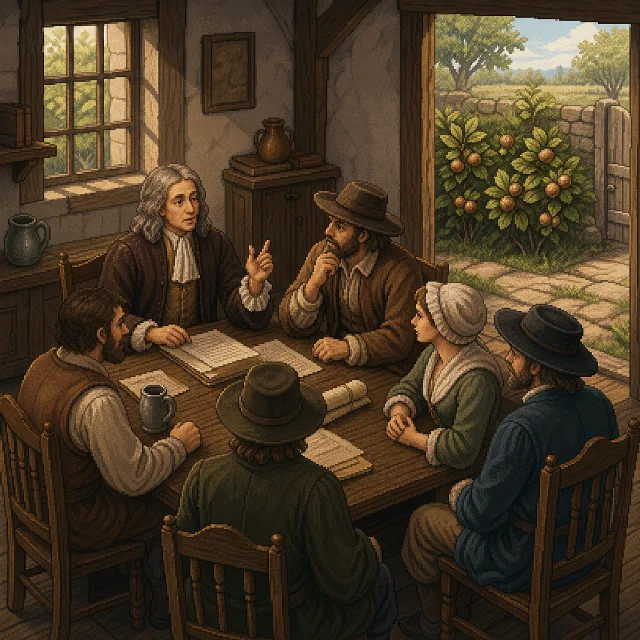
Second Treatise of Government
Locke's theory of natural rights, consent, property, and political legitimacy.
About this book
The Second Treatise of Government argues that political authority arises from consent and exists to protect life, liberty, and property. Locke explains the state of nature, labor, property, legislative power, tyranny, and the right of resistance. The book became central to modern liberal politics because it grounds government in trust, not inheritance, and makes rulers accountable to the people.
How do you want to read?
- Book II, Part 14409 words
This chapter explores the true foundation of political power, distinguishing it from paternal authority. Locke invites us to consider the natural state of mankind—a condition of freedom and equality governed by natural law.
- Book II, Part 24340 words
As we move from the state of war to the foundations of civil society, Locke now turns to the origins of property. How can common resources become private? The answer lies in the labor of our own bodies.
- Book II, Part 34310 words
Locke now examines how property in land arose through labor and consent, using biblical and American examples to show that value comes from human effort, not mere possession.
- Book II, Part 44269 words
Locke now sharpens the distinction between parental and political power, arguing that freedom comes only with reason. Children remain subject to parents until they reach that age of discretion, a limit that no amount of paternal authority can overstep.
- Book II, Part 54334 words
In this chapter, Locke examines the foundations of political society by distinguishing it from natural associations like the family. He argues that true civil society requires surrendering private judgment to a common authority.
- Book II, Part 64462 words
Locke now explains how free individuals form a political society. The key is unanimous consent to join, which then binds each person to majority decisions. Without this, no community can act or endure.
- Book II, Part 74270 words
Locke now tackles a stubborn objection: that we are born subjects. He argues this cannot be true, because then no one would be free to create new governments—yet history shows exactly that happening.
- Book II, Part 84401 words
Locke now turns to the limits of legislative power, arguing it must serve the public good and operate under standing laws. He challenges arbitrary rule and insists on consent for taxation.
- Book II, Part 94547 words
Locke now examines how executive and legislative powers relate, especially when the executive must act without or against the law. He introduces prerogative as a discretionary power for the public good, setting the stage for its limits and justification.
- Book II, Part 104620 words
Locke now turns from the origins of government to its disruption, examining conquest. He warns that the clamor of war often drowns out the consent that alone legitimizes rule, setting the stage for a careful analysis of a conqueror's true authority.
- Book II, Part 114553 words
Locke turns to the limits of conquest, arguing that force alone never grants rightful authority. He examines how descendants of the conquered retain their rights, even under imposed governments.
- Book II, Part 124429 words
Locke now examines how a government dissolves from within, focusing on alterations to the legislative. He argues that when the legislative is broken or changed without the people's consent, the government effectively dies.
- Book II, Part 133378 words
Locke examines when resistance to a king becomes lawful, drawing on Barclay's own admission that even a tyrant may be opposed. He narrows the conditions to extreme cases where the king acts against the common good.
- Book II, Part 14409 words
- Book II, Part 1971 words
This chapter explores the origins of political power, tracing it back to the natural condition of mankind. Locke contrasts the state of nature—a realm of freedom and equality—with the state of war that arises when force is used without a common judge.
- Book II, Part 2990 words
In this chapter, Locke explores how we move from a state of war to civil society, the true nature of slavery, and the origins of private property through labor. The arguments build a foundation for understanding rights and ownership.
- Book II, Part 3909 words
Locke now examines how labor justifies property and how money, by mutual consent, permits unequal holdings beyond immediate use. The argument traces ownership from common resources to lawful inequality, setting the stage for a foundational shift in economic relations.
- Book II, Part 4981 words
In this chapter, Locke explores the nature of parental power, arguing it is temporary and rooted in the duty to care for children until they gain reason. This sets the stage for a crucial distinction between paternal and political authority.
- Book II, Part 5965 words
Locke now turns from natural societies to define what truly constitutes political society. He argues that civil government arises only when individuals surrender their personal power to judge and punish, submitting to a common authority with established laws.
- Book II, Part 6894 words
As we explore the birth of political societies, Locke invites us to consider how free individuals might voluntarily unite. The path from natural liberty to civil government hinges on a single, profound act: consent.
- Book II, Part 7815 words
How do we become subjects of a government? Locke challenges the notion of birthright allegiance, arguing that no one is born a subject. Instead, he explores the role of consent—both express and tacit—in creating political obligation.
- Book II, Part 8919 words
Locke now sets the boundaries of legislative power, arguing it must serve the public good and cannot be arbitrary. He insists on standing laws, consent for taxation, and separation of powers as essential safeguards.
- Book II, Part 9920 words
This chapter examines the relationship between legislative and executive powers, the nature of prerogative, and the distinctions among paternal, political, and despotic power. Locke explores when the executive may act beyond law for public good.
- Book II, Part 101062 words
Locke distinguishes three forms of power—paternal, political, and despotical—then examines whether conquest can ever create legitimate authority. He argues that force alone cannot establish government, setting the stage for a deeper look at the limits of a conqueror's rights.
- Book II, Part 11971 words
In this chapter, Locke examines the limits of conquest and the nature of tyranny. He argues that rightful authority requires consent, and that force alone cannot justify dominion.
- Book II, Part 12989 words
As we enter Chapter 12, Locke examines what dissolves a government. He argues that when the legislative is altered or acts against its trust, the government dies, leaving the people free to establish a new one.
- Book II, Part 13724 words
This chapter examines when resistance to a ruler becomes lawful, drawing on Barclay's arguments about forfeiture of power. Locke clarifies the conditions under which a king may be resisted and who has the right to judge such cases.
- Book II, Part 1971 words
- The State of Nature and the Origins of Property1302 words
Locke now turns from the state of nature to the origins of property. How can common resources become private? The answer lies in the labor of our own bodies, which we own.
- The Formation and Limits of Political Society1340 words
Locke now sharpens the distinction between parental and political power, arguing that freedom comes only with reason. Children remain subject to parents until they reach that age of discretion, a limit that no amount of paternal authority can overstep.
- The Dissolution of Government and the Right of Resistance853 words
In this chapter, Locke explores how governments dissolve from within, focusing on the legislative's alteration or betrayal of trust. He argues that when rulers act against the people's good, the government effectively dies.
- The State of Nature and the Origins of Property1302 words
Related works
Responses
- The Social Contract
Locke maakt regering afhankelijk van toestemming en rechten; Rousseau radicaliseert de vraag wat echte gezamenlijke vrijheid dan betekent.
Thematic kin
- A Letter Concerning Toleration
De Second Treatise wordt concreter naast de Letter: instemming en rechten hebben ook een religieuze en gewetensdimensie.
Later works building on this
- Common Sense
Locke levert het vocabulaire van rechten en toestemming; Paine vertaalt dat naar revolutionaire taal voor gewone lezers.