Max Havelaar
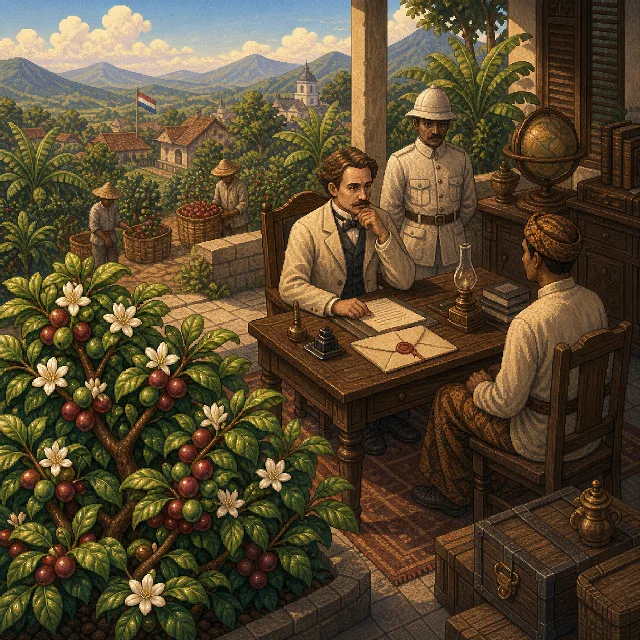
Max Havelaar
A fierce Dutch novel against colonial exploitation and moral complacency.
About this book
Max Havelaar attacks the abuses of Dutch colonial rule in the East Indies through satire, layered narration, bureaucratic comedy, and moral outrage. Multatuli refuses to let readers hide behind paperwork, respectability, or distance. The novel is both literary experiment and political indictment, asking what truth can do when a comfortable society has learned not to hear the suffering on which it profits.
How do you want to read?
- Eerste Hoofdstuk2299 words
In this chapter, we meet a coffee broker who values truth above all. He explains why he distrusts fiction and poetry, setting the stage for a practical worldview.
- Tweede Hoofdstuk2673 words
As the exchange stirs with spring auctions, our narrator reflects on business rivalries and a chance encounter that will alter his path.
- Derde Hoofdstuk2502 words
Droogstoppel receives an unexpected letter from an old schoolmate, Sjaalman, who is down on his luck. The letter contains a strange request and a bundle of manuscripts. As Droogstoppel reads, his irritation grows, but he cannot yet foresee how these papers will resurface.
- Vierde Hoofdstuk, Part 16193 words
The narrator, a coffee broker, begins to sift through Sjaalman's manuscripts, driven by both business curiosity and moral vigilance. What he finds surprises him, setting the stage for a decision that will shape the chapter.
- Vierde Hoofdstuk, Part 21675 words
Droogstoppel, needing help with Stern's manuscript, decides to visit Sjaalman's home. He is determined to handle the matter himself, wary of exposing Stern or Frits to questionable influences. The address leads him to a modest dwelling, where an unexpected scene awaits.
- Vijfde Hoofdstuk, Part 14762 words
The journey to Lebak is a test of endurance, where mud and delay are constants. But as the carriage jolts forward, a deeper system of power and exploitation begins to reveal itself beneath the surface of colonial routine.
- Vijfde Hoofdstuk, Part 21132 words
This chapter explores the tension between Javanese customs of submission and the official duty of European officials to protect the population from exploitation.
- Zesde Hoofdstuk, Part 14131 words
Verbrugge and the Regent wait in the pendoppo, exchanging polite but empty words. Duclari arrives and shares his blunt opinion of Havelaar. The atmosphere is tense with anticipation.
- Zesde Hoofdstuk, Part 21892 words
This chapter paints a detailed portrait of Max Havelaar, a man of striking contradictions. His youthful appearance belies a depth of experience and a complex inner world that defies easy categorization.
- Zevende Hoofdstuk, Part 14678 words
As Havelaar steps into Lebak, the air thickens with unspoken tensions. The Regent's eager welcome and Verbrugge's guarded glances hint at deeper currents beneath the surface.
- Zevende Hoofdstuk, Part 22177 words
In Lebak, Havelaar and Tine arrive with hopeful hearts, dreaming of a frugal life and a peaceful future. Their love for each other and their child fills the new home with warmth, yet shadows of past debts and Max's generous nature linger, hinting at trials to come.
- Achtste Hoofdstuk, Part 14666 words
Havelaar convenes the chiefs of Lebak, his heart full of purpose. As they gather, he prepares to speak not as a bureaucrat but as a visionary, his words poised to challenge their understanding of justice and duty.
- Achtste Hoofdstuk, Part 21974 words
Havelaar presses Verbrugge with hard truths about the regent's corruption, laying bare abuses that have long been hidden. The evidence mounts as he reveals what the late Slotering had documented.
- Negende Hoofdstuk4210 words
In this chapter, the narrator digresses to defend his literary choices and scold his son Frits before recounting a sermon that ties forced labor to coffee cultivation. The tension between his commercial goals and Stern's artistic ambitions comes to a head.
- Tiende Hoofdstuk1767 words
Droogstoppel sets a trap for Stern, testing his truthfulness by challenging a poem he recites. He aims to prove that poetry is full of lies and that Stern should focus on practical knowledge instead.
- Elfde Hoofdstuk, Part 14785 words
Havelaar's dinner conversation drifts into philosophy and memory. He argues that stillness is death, and true beauty requires movement and narrative.
- Elfde Hoofdstuk, Part 21513 words
Havelaar, still smarting from his earlier frustrations, turns to storytelling to soothe his mood. He begins a parable about a stonecutter whose desires lead him on a restless journey, a tale that mirrors his own discontent.
- Twaalfde Hoofdstuk3592 words
Havelaar begins to recount the events that led to his suspension in Padang, weaving a tale that touches on his conflict with General Vandamme and the nature of human criticism.
- Dertiende Hoofdstuk, Part 14918 words
As Havelaar's story deepens, he reveals the circumstances of his suspension, hinting at a clash with authority that will shape his fate.
- Dertiende Hoofdstuk, Part 2365 words
Havelaar plans to visit Mrs. Slotering, but Tine has already met her. Mrs. Slotering prefers to keep her own household, a decision that suits everyone. The arrangement reveals unspoken tensions beneath polite gestures.
- Veertiende Hoofdstuk, Part 14732 words
Havelaar continues his story, revealing the political tensions in Sumatra. He describes General Vandamme's ambitions and the fragile peace in the Batak lands, setting the stage for a conflict over justice and loyalty.
- Veertiende Hoofdstuk, Part 24824 words
This chapter delves into the subtle abuses of power within the colonial system, using the maintenance of official residences as a lens. It explores how small transgressions can lead to widespread corruption, setting the stage for Havelaar's principled stand.
- Veertiende Hoofdstuk, Part 3361 words
In this brief chapter, a child's innocent questions about fireflies and stars reveal his deep love for his mother. The scene, though simple, is carefully chosen by the author to build our connection to the main character.
- Vijftiende Hoofdstuk, Part 14794 words
Havelaar reflects on his predecessor's pattern of oral complaints and retractions, a system that silenced truth and punished the vulnerable. He now faces a similar tension with the controller, who hesitates to speak openly about corruption.
- Vijftiende Hoofdstuk, Part 2580 words
The narrator grapples with the necessity of satire, reflecting on how Havelaar's sincere style failed to effect change. He questions whether his own writing must adopt a motley appearance to be heard.
- Zestiende Hoofdstuk, Part 14950 words
Havelaar faces a delicate dilemma as the Regent of Tjanjor announces a visit, threatening to worsen the villagers' burdens. Meanwhile, secret complaints begin to surface, hinting at deeper injustices.
- Zestiende Hoofdstuk, Part 21738 words
The narrator's irritation with his son Frits grows, as the boy's irreverence at catechism class echoes the troubling influence of Sjaalman's writings. Meanwhile, a chance encounter with Sjaalman's impoverished family reinforces the narrator's conviction that poverty is a sign of moral failure.
- Zeventiende Hoofdstuk, Part 14828 words
In this chapter, Saïdjah's family faces repeated losses at the hands of the district chief, driving Saïdjah to seek fortune in Batavia. The story weaves together themes of oppression, love, and sacrifice.
- Zeventiende Hoofdstuk, Part 24174 words
Saïdjah waits beneath the ketapan tree, watching the stars fade as dawn approaches. He is certain Adinda will come, and his heart swells with the hope of reunion after three years away.
- Achttiende Hoofdstuk4716 words
Havelaar's resolve hardens as he uncovers the fate of his predecessor. The shadows of corruption deepen, and the air grows heavy with suspicion. A quiet afternoon holds the weight of a revelation.
- Negentiende Hoofdstuk3303 words
Havelaar prepares for the resident's visit, knowing it may be an attempt to soften his resolve. He sends a letter ahead to make his position unmistakably clear.
- Twintigste Hoofdstuk, Part 14651 words
As evening falls in Lebak, Havelaar tries to find solace in domestic life, drawing an embroidery pattern while Tine reads. But the quiet scene cannot mask the storm brewing within him—frustration over delayed justice and the suffering of the people weighs heavily on his mind.
- Twintigste Hoofdstuk, Part 24257 words
Multatuli turns his pen directly to the Dutch government and king, issuing a stark warning about the consequences of ignoring colonial abuses. He defends his book as a factual account, not mere fiction, and reflects on the emotional toll of revisiting these events.
- Twintigste Hoofdstuk, Part 3494 words
In this chapter, Multatuli responds to persistent critics who attack his work for profit. He compares them to wasps and shipworms, lamenting that such cheap slander distracts him from more important writing.
- Eerste Hoofdstuk2299 words
- Eerste Hoofdstuk547 words
In this chapter, we meet a narrator who values truth above all. He sets the stage for his story by declaring his disdain for fiction and his commitment to practical reality.
- Tweede Hoofdstuk535 words
In the coffee exchange, business is steady but rivalry sharpens. A letter to Hamburg secures an advantage, yet a chance meeting on the Kalverstraat stirs old memories and new obligations.
- Derde Hoofdstuk576 words
As Droogstoppel returns from the Exchange, an unexpected visit and a bulky package set the stage for a tale he never asked for. The chapter unfolds through a letter and a recitation, revealing old ties and new troubles.
- Vierde Hoofdstuk, Part 11369 words
As the coffee broker sifts through Sjaalman's bundle, he finds more than he bargained for—a mix of curiosity and moral concern begins to stir.
- Vierde Hoofdstuk, Part 2367 words
Droogstoppel visits Sjaalman's family to get help with Stern's manuscript. He finds their appearance and home unsettling, revealing his colonial prejudices.
- Vijfde Hoofdstuk, Part 11049 words
The road to Lebak is a muddy trial, but the arrival of a new assistant resident draws a grand reception. Beneath the ceremony lies a complex colonial hierarchy where power and wealth are unequally balanced.
- Vijfde Hoofdstuk, Part 2285 words
This chapter explores the tension between Javanese customs of submission and the colonial government's professed duty to protect. It examines how regents exploit traditional obligations, and why European officials struggle to intervene.
- Zesde Hoofdstuk, Part 1806 words
In the pendopo, Controller Verbrugge and the Regent of Lebak wait for the new assistant resident. Their polite conversation hints at tensions beneath the surface, as Duclari arrives with sharp opinions about Havelaar's character.
- Zesde Hoofdstuk, Part 2409 words
This chapter paints a detailed portrait of Max Havelaar, a man of striking contradictions. His youthful appearance belies a life rich with experience, inviting us to explore the depths beneath the surface.
- Zevende Hoofdstuk, Part 11026 words
Havelaar steps into Lebak, where first impressions and formalities set the stage. The colonial machinery grinds forward, but beneath the surface, character and hierarchy begin to reveal themselves.
- Zevende Hoofdstuk, Part 2487 words
In this chapter, Havelaar and Tine arrive in Lebak, hopeful for a simple life. Their optimism and plans for frugality set the stage, but echoes of their past and Tine's unwavering faith in Max hint at the trials ahead.
- Achtste Hoofdstuk, Part 11070 words
Havelaar gathers the chiefs for a formal Sebah. His words rise like a prophecy, calling them to justice and duty. The room waits, sensing something greater than routine.
- Achtste Hoofdstuk, Part 2487 words
In this chapter, Havelaar confronts Verbrugge with evidence of the regent's abuses. He reveals how the regent's family extorts money and labor from the people, citing documentation from the previous assistant resident.
- Negende Hoofdstuk939 words
In this chapter, the narrator defends his literary choices and admonishes his son Frits. He recounts a sermon that links forced labor to the conversion of Javanese, tying it to coffee cultivation.
- Tiende Hoofdstuk414 words
Droogstoppel, ever the moralist, sets a trap for Stern to expose what he sees as the lies of poetry. He believes truth must be practical and measurable, like coffee statistics.
- Elfde Hoofdstuk, Part 11085 words
In this chapter, Havelaar shares his philosophy on beauty and movement during a dinner conversation, setting the stage for a reflective anecdote from his past in Sumatra.
- Elfde Hoofdstuk, Part 2347 words
Havelaar shares a Japanese tale with Si Oepi Keteh, hoping to soothe his own restless ambition. The story unfolds as a quiet lesson, but its meaning will depend on how each listener hears it.
- Twaalfde Hoofdstuk789 words
Havelaar shares a story of theft and suspension in Padang, revealing his conflict with General Vandamme. The tale unfolds with humor and bitterness, setting the stage for deeper reflections on human nature and criticism.
- Dertiende Hoofdstuk, Part 11121 words
As Havelaar faces the consequences of his defiance, the story pauses to consider the setting that shaped his ordeal. The narrator prepares us to see beyond mere events, into the world where injustice took root.
- Dertiende Hoofdstuk, Part 2111 words
As Havelaar navigates the complexities of colonial life, a delicate household arrangement unfolds. The arrival of Mrs. Slotering introduces a quiet negotiation of boundaries and convenience.
- Veertiende Hoofdstuk, Part 11020 words
In this chapter, Havelaar recounts a tense confrontation with General Vandamme over a manipulated legal case. The general's actions reveal the political pressures behind colonial justice.
- Veertiende Hoofdstuk, Part 21084 words
This chapter examines how official reports in the colony are systematically falsified, and contrasts this with Havelaar's personal integrity, as seen in a tender poetic exchange.
- Veertiende Hoofdstuk, Part 3111 words
A child's innocent wish to catch a star for his mother reveals the depth of his love. The author risks appearing motley to show us this tender moment, preparing us to care deeply for the boy.
- Vijftiende Hoofdstuk, Part 1983 words
Havelaar reflects on his predecessor's flawed system and the cost of half-measures. As he confronts a new challenge, the tension between compassion and duty grows.
- Vijftiende Hoofdstuk, Part 2149 words
In this chapter, the narrator wrestles with the necessity of satire, reflecting on Havelaar's sincere yet failed approach. Havelaar's observations of bureaucratic maladies set the stage for a confrontation over justice in Lebak.
- Zestiende Hoofdstuk, Part 11110 words
As Havelaar faces the Regent's costly visit, he also receives secret complaints from oppressed villagers. The chapter then shifts to a story about Saïdjah, illustrating the human cost of colonial rule.
- Zestiende Hoofdstuk, Part 2394 words
The narrator reflects on Sjaalman's poverty and defends his own principles. He worries about his son Frits's irreverence, which he blames on Sjaalman's writings. The chapter reveals the narrator's rigid worldview.
- Zeventiende Hoofdstuk, Part 11088 words
Saïdjah's family endures loss under the district chief's oppression, driving him to seek fortune in Batavia. His bond with Adinda and a promise of return shape his journey.
- Zeventiende Hoofdstuk, Part 2792 words
Saïdjah returns to Badoer, his heart full of hope. But the village holds no welcome—only silence and absence. The ketapan tree waits, but Adinda does not come.
- Achttiende Hoofdstuk1006 words
Havelaar, sensing deeper corruption, presses Mevrouw Slotering for the truth about her husband's death. As suspicions of poisoning surface, he must decide how to act on the information he uncovers.
- Negentiende Hoofdstuk750 words
Havelaar's resolve solidifies as he confronts the colonial machinery. His letter stands firm, demanding accountability for the regent's abuses. The air thickens with tension as the resident arrives, seeking compromise where none is possible.
- Twintigste Hoofdstuk, Part 11015 words
As evening falls, Havelaar finds solace in his family, but the weight of injustice presses upon him. The awaited government decision looms, threatening to shatter his hopes for justice.
- Twintigste Hoofdstuk, Part 2965 words
In this chapter, Multatuli addresses the Dutch authorities directly, warning of dire consequences if they ignore the injustices in the Indies. He reflects on the personal toll of revisiting his work and the nation's failure to act.
- Twintigste Hoofdstuk, Part 3150 words
In this chapter, the author reflects on the persistence of slander and the need to distinguish genuine criticism from mere noise. He sets the stage for a firm stance against petty attacks.
- Eerste Hoofdstuk547 words
- The Coffee Broker's Worldview1428 words
In this chapter, we meet a coffee broker who values truth above all else. He explains his distrust of fiction and poetry, setting the stage for a practical worldview.
- Havelaar's Arrival in Lebak1416 words
As the narrator sifts through Sjaalman's manuscripts, curiosity and caution collide. The bundle reveals unexpected depth, forcing a decision that will ripple through the chapter.
- Stories Within Stories1273 words
In this chapter, the narrator defends his literary choices and scolds his son Frits before recounting a sermon linking forced labor to coffee cultivation. Tension between his commercial goals and Stern's artistic ambitions comes to a head.
- The Tragedy of Saïdjah and Adinda1370 words
Havelaar reflects on his predecessor's pattern of oral complaints and retractions, a system that silenced truth. Now, he faces a similar tension. Meanwhile, the story of Saïdjah begins-a tale of loss and love under oppression.
- The Final Stand and Appeal1404 words
In the quiet of an afternoon, Havelaar learns the truth about his predecessor's death, hardening his resolve against the corruption that shadows Lebak.
- The Coffee Broker's Worldview1428 words
Related works
Countervoices
- An Inquiry into the Nature and Causes of the Wealth of Nations
Max Havelaar toont de morele kosten van koloniale handel; Smith onderzoekt de mechanismen van welvaart en economische orde.
Thematic kin
- The Communist Manifesto
Max Havelaar krijgt een theoretische verwant in het Manifest: beide teksten weigeren economische orde als neutraal te zien.