Confessions
Confessions
Augustine's searching story of memory, desire, sin, and grace.
About this book
Confessions is Augustine's account of a restless life being read before God. It moves from childhood, ambition, friendship, and desire toward conversion, prayer, memory, and the mystery of time. The book is not simply autobiography; it is a spiritual and philosophical investigation into why the self is divided, why it longs, and how grace can reorder a life from within.
How do you want to read?
- Book I, Part 14653 words
Augustine opens with a prayer, wrestling with how to call upon a God who already fills all things. He probes the mystery of divine presence, seeking rest for a restless heart.
- Book I, Part 22633 words
Augustine turns his gaze inward, examining the tangled roots of his boyhood sins. He recalls how his education prized pagan tales over truth, and how he wept for fictional lovers while blind to his own spiritual death.
- Book II3834 words
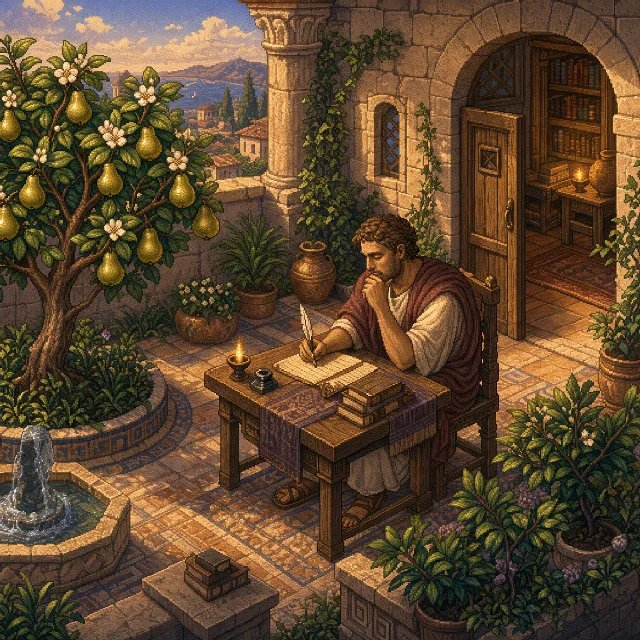
Augustine turns to a memory from his youth—a petty theft of pears—to probe the depths of human sin. He recalls not just the act but the strange delight he took in wrongdoing for its own sake.
- Book III, Part 14676 words
Augustine arrives in Carthage, swept into lust and theater, seeking love in all the wrong places. Yet even in his dissipation, a deeper hunger stirs—one that will soon lead him to a life-changing book.
- Book III, Part 21042 words
Augustine reflects on his past entanglements with Manichaean absurdities, while his mother Monica persists in tearful prayer. A dream and a bishop’s prophecy offer quiet assurance, though the outcome remains hidden in the years ahead.
- Book IV, Part 14420 words
Augustine looks back on nine years of wandering, caught between ambition and superstition. He recalls a dear friend's death and the grief that followed, teaching him where true love must rest.
- Book IV, Part 22694 words
Augustine continues his confession, reflecting on his youthful errors and the subtle pride that entangled his love for beauty and learning. He recalls his lost books on the fair and fit, and his admiration for an orator, unaware of God's hidden guidance.
- Book V, Part 14467 words
Augustine's long search for truth brings him face to face with Faustus, a Manichean bishop famed for eloquence. What he discovers challenges his expectations and sets him on a new path.
- Book V, Part 22332 words
Augustine lingers in Rome, still entangled with Manichaean friends yet growing disenchanted. His mother's prayers follow him, and a new city—Milan—beckons with the promise of Ambrose's preaching.
- Book VI, Part 14660 words
As Augustine’s mother arrives with unwavering faith, his own path remains uncertain. He lingers between doubt and belief, observing those around him—Ambrose, a beggar, his friend Alypius—each reflecting a different facet of the search for truth.
- Book VI, Part 23339 words
Augustine turns to the story of his friend Alypius, whose integrity was tested in unexpected ways. As he recounts these episodes, we see how God prepared Alypius for a life of service—even through apparent misfortune.
- Book VII, Part 14442 words
Augustine reflects on his early manhood, still trapped in material conceptions of God. He wrestles with the nature of the divine, seeking to understand how an incorruptible God can exist without spatial limits.
- Book VII, Part 24211 words
Augustine turns from the books of the Platonists to the pages of Scripture, where he finds not only lofty truths but the humility of God made flesh. He begins to see the difference between knowing about the Word and being transformed by the Word made man.
- Book VIII, Part 14579 words
Augustine seeks guidance from Simplicianus, hoping to find clarity in his struggle between worldly desires and the call of faith. He hears the story of Victorinus, a renowned scholar who humbly embraced Christianity.
- Book VIII, Part 23691 words
Augustine's inner turmoil reaches a climax as he confronts his own divided will. The story of others' conversions forces him to see himself clearly, setting the stage for a decisive moment.
- Book IX, Part 15389 words
Augustine reflects on his conversion, the joy of release from worldly ambitions, and his quiet decision to leave his teaching post. He prepares to step away from the marketplace of words, guided by a newfound love for God.
- Book IX, Part 24549 words
Augustine now turns to his mother's early life, revealing a hidden fault and its unexpected cure. Her journey from secret vice to virtuous wife unfolds through small steps and sharp words.
- Book X, Part 15199 words
Augustine turns inward, probing the vast chambers of memory and the depths of his love for God. He seeks to know the Creator through the testimony of his own soul, confessing not only past sins but his present state before God and others.
- Book X, Part 24765 words
Augustine continues his exploration of memory, now examining how it holds not only images but also abstract knowledge and past emotions. He marvels at the mind's ability to recall without being affected by the recalled feelings.
- Book X, Part 35044 words
Augustine continues his search for God within memory, confessing that God dwells there not as an image but as truth itself. He reflects on his delayed love for divine beauty and the ongoing trial of human life.
- Book X, Part 43382 words
Augustine reflects on the persistent temptations of curiosity and the desire for praise, even after many sins have been overcome. He acknowledges how easily the mind is distracted by trivial things, and how the love of human approval can subtly undermine devotion to God.
- Book XI, Part 14479 words
Augustine turns his gaze to the eternal Word through which God creates, and wrestles with the mystery of time. He prepares to explore how all things, including time itself, are made by the timeless God.
- Book XI, Part 24512 words
Augustine turns inward to examine how we measure time, confronting the paradox that past and future seem not to exist. He prepares to argue that time is a distension of the mind, measured through memory, attention, and expectation.
- Book XI, Part 3904 words
As we step into this chapter, we find a mind wrestling with time, memory, and expectation. The Psalmist's meditation unfolds, but the outcome remains unwritten—a journey through distraction toward stillness.
- Book XII, Part 14366 words
Augustine turns his restless heart toward the deep mysteries of creation, wrestling with what it means for matter to be formless and how the heaven of heavens stands outside time.
- Book XII, Part 24575 words
Augustine enters a reflective pause, acknowledging the diversity of interpretations of Genesis. He prepares to weigh these views not by contention but by charity, seeking the truth that unites them without dismissing any that align with faith.
- Book XII, Part 31587 words
Augustine reflects on the many ways to interpret a single verse of Scripture. He invites us to consider how multiple true meanings can coexist, each shedding light on the mystery of creation.
- Book XIII, Part 13245 words
Augustine continues his meditation on creation, exploring how the soul moves from darkness to light through grace. He reflects on the Trinity's role in forming all things from nothing, and on love as the weight that draws us toward God.
- Book XIII, Part 24395 words
Augustine turns from the soul's inner landscape to the Church's public witness. He reads the creation of lights in the firmament as a figure for spiritual gifts distributed among believers. The chapter explores how these gifts illuminate the earth and guide the faithful through time.
- Book XIII, Part 33786 words
Augustine explores the dual meaning of 'increase and multiply'—literal for all seed-bearing life, allegorical for spiritual abundance. He connects this blessing to the human ability to express one truth in many ways and understand many truths in one.
- Book I, Part 14653 words
- Book I, Part 11018 words
Augustine opens his Confessions with a prayer, praising God and confessing the restlessness of the human heart. He reflects on his infancy and boyhood, probing the nature of sin and the beginnings of memory and language.
- Book I, Part 2604 words
Augustine turns inward to examine his boyhood, where he first learned to love stories more than truth. He sees how even then, his heart was wandering.
- Book II852 words
Augustine continues his confession, now recalling a youthful theft that reveals the depths of human sin. He examines the motives behind an act done for no gain, only for the thrill of transgression.
- Book III, Part 1987 words
Augustine arrives in Carthage, where he plunges into lust and theatrical pleasures. Yet a book by Cicero awakens a hunger for wisdom, though his pride leads him astray. This chapter traces his restless search and missteps.
- Book III, Part 2250 words
Augustine's mother Monica weeps for his soul, clinging to a dream and a bishop's promise. Her tears and prayers shape a hope that defies his current folly.
- Book IV, Part 1877 words
Augustine recounts years of deception and grief, probing the soul's restless search. He prepares to show how love for mutable things leads to sorrow, while true rest is found only in God.
- Book IV, Part 2630 words
Augustine looks back on his early writings and intellectual pursuits, questioning what truly moved him. He recalls his love of beauty and human praise, unaware of deeper truths.
- Book V, Part 11011 words
As Augustine prepares to meet Faustus, his hopes are high, yet a quiet tension lingers. Will this renowned teacher finally answer the questions that have troubled him?
- Book V, Part 2559 words
Augustine, still entangled in Manichaean errors, moves to Milan. There, he hears Bishop Ambrose preach, drawn more by eloquence than truth. Yet seeds of doubt about his old beliefs begin to stir.
- Book VI, Part 11009 words
Augustine's mother arrives, strengthening his ties to Ambrose. He wrestles with doubt, seeking assurance in faith. Through encounters and stories, he begins to see truth differently.
- Book VI, Part 2692 words
Augustine reflects on his friend Alypius's integrity and his own prolonged struggle with lust and indecision, as he clings to worldly comforts while yearning for wisdom.
- Book VII, Part 11018 words
Augustine, now entering early manhood, grapples with the nature of God and the origin of evil. He rejects Manichaean dualism and astrology, yet still seeks understanding.
- Book VII, Part 2903 words
Augustine now contrasts the lofty insights of Platonist philosophy with the humble, healing path of Christ. He recounts his inward vision of unchangeable light and his growing understanding of evil as a perversion of the will.
- Book VIII, Part 1920 words
Augustine, still torn between two wills, seeks counsel from Simplicianus, who tells him the story of Victorinus’s conversion—a proud scholar who humbled himself to confess Christ publicly.
- Book VIII, Part 2830 words
Augustine stands at the precipice of decision, torn between old habits and the call to a new life. His inner turmoil reaches a peak as he confronts the divided will within himself.
- Book IX, Part 11189 words
Augustine's journey to full conversion reaches its climax as he prepares to leave his teaching post and embrace baptism. The inner transformation he has long sought now finds outward expression.
- Book IX, Part 21028 words
In this chapter, Augustine reflects on his mother Monica's life and death, sharing intimate memories of her virtues and their shared spiritual aspirations.
- Book X, Part 11122 words
Augustine turns inward, exploring the vast chambers of memory and the love that draws him toward God. He seeks to know what he truly loves when he loves his Creator.
- Book X, Part 21082 words
Augustine turns inward to explore the vast realm of memory, where images, affections, and even the mind itself reside. He marvels at its power and depth, seeking to understand how the desire for happiness and truth is rooted in this inner faculty.
- Book X, Part 31146 words
Augustine probes the depths of memory, seeking where God dwells. He confesses the lingering pull of old habits and the daily battle against sensory temptations, all while clinging to the hope of God's mercy.
- Book X, Part 4773 words
Augustine reflects on the daily temptations of curiosity and praise, acknowledging how easily they distract him. He turns to God, recognizing his need for grace to overcome these subtle but persistent struggles.
- Book XI, Part 11030 words
Augustine turns to the mystery of creation through God's eternal Word. He grapples with questions about time and what God did before the world began, seeking to understand how the Creator relates to His creation.
- Book XI, Part 21040 words
Augustine turns inward to solve the puzzle of time. He finds that past and future exist only as memory and expectation in the mind. The present itself is fleeting, yet we measure intervals. This leads him to a startling conclusion.
- Book XI, Part 3231 words
Before we begin, consider how our minds stretch between memory and expectation. This chapter explores that tension, using a familiar Psalm as a mirror for the soul's journey through time.
- Book XII, Part 1972 words
Augustine turns his gaze to the creation of heaven and earth, seeking to understand the formless matter and the eternal heaven of heavens. He ponders how these relate to time and the unchanging God.
- Book XII, Part 2999 words
In this chapter, Augustine explores the richness of multiple true interpretations of Scripture, showing how diverse understandings can coexist without harming faith.
- Book XII, Part 3400 words
Augustine considers the many ways readers interpret Genesis 1:1. He shows that different views can all be true if they align with charity. The key is not to insist on one meaning but to seek harmony in truth.
- Book XIII, Part 1663 words
In this chapter, Augustine explores the soul's journey from darkness to light through grace, using the metaphor of love as weight. He reflects on the Trinity's role in creation and the ordering of human desires.
- Book XIII, Part 2969 words
Augustine turns to the Genesis blessing 'increase and multiply,' exploring its deeper meaning for spiritual growth and the Church's mission. How does this ancient command shape our understanding of divine gifts and human fruitfulness?
- Book XIII, Part 3782 words
Augustine explores the layered meanings of 'increase and multiply,' moving from literal seeds to the rich allegories of spiritual growth. He invites us to see how God's Word yields multiple interpretations, each bearing fruit in our understanding.
- Book I, Part 11018 words
- The Restless Heart1309 words
Augustine's confession turns inward, probing the tangled roots of his boyhood sins. He recalls how education prized pagan tales over truth, and how he wept for fictional lovers while blind to his own spiritual death.
- The Search for Truth934 words
In Carthage, Augustine plunges into sensual pleasures and theatrical illusions, seeking love but finding only emptiness. Yet a deeper hunger stirs, preparing him for a life-changing encounter with a book.
- Disillusionment and New Horizons1308 words
Augustine's long search for truth brings him face to face with Faustus, a Manichean bishop famed for eloquence. What he discovers challenges his expectations and sets him on a new path.
- The Climax of Conversion1296 words
Augustine stands at the threshold of decision, his will divided between old habits and the call of grace. The stories of others' conversions press him toward a crisis he can no longer avoid.
- Memory, Time, and the Soul1288 words
As Augustine recalls his mother's hidden fault and its cure, he also remembers their shared vision at Ostia. Her final words and death draw him into a grief that reveals how deeply human bonds shape the soul.
- Creation and Interpretation884 words
Augustine turns his restless heart toward the deep mysteries of creation, wrestling with what it means for matter to be formless and how the heaven of heavens stands outside time.
- The Restless Heart1309 words
Related works
Genre kin
- Essays (selection)
Augustinus onderzoekt zichzelf voor God; Montaigne onderzoekt zichzelf zonder dezelfde theologische zekerheid. Beiden maken het innerlijk tot tekst.
Thematic kin
- The Imitation of Christ
Augustinus maakt innerlijkheid dramatisch en autobiografisch; De Navolging van Christus maakt haar tot dagelijkse oefening.
Countervoices
- Hayy ibn Yaqzan
Augustinus vindt waarheid via herinnering, schuld en genade; Ibn Tufail laat een mens door eigen waarneming en rede opstijgen.